
The Women's Empowerment Principles (WEPs) help companies translate their commitments to gender equality into practical action and measurable results across leadership, workplace, marketplace and community.
Established by UN Women and the UN Global Compact in 2010, the WEPs Secretariat is managed by UN Women. The WEPs provide a globally recognized framework, a community of peers and experts, and practical tools that help companies support their workforce, strengthen business practices, build inclusive value chains and demonstrate progress.
Watch how companies around the world are using the WEPs to move from commitment to action and create meaningful impact.
Why Companies Choose the WEPs
Employees, investors, customers and regulators increasingly expect companies to show, not simply state, how they are advancing gender equality.
The Women's Empowerment Principles help companies respond with credibility and move from commitment to action in four ways: through a globally recognized framework, a worldwide community, practical tools and guidance, and a structured approach to demonstrate measurable progress.
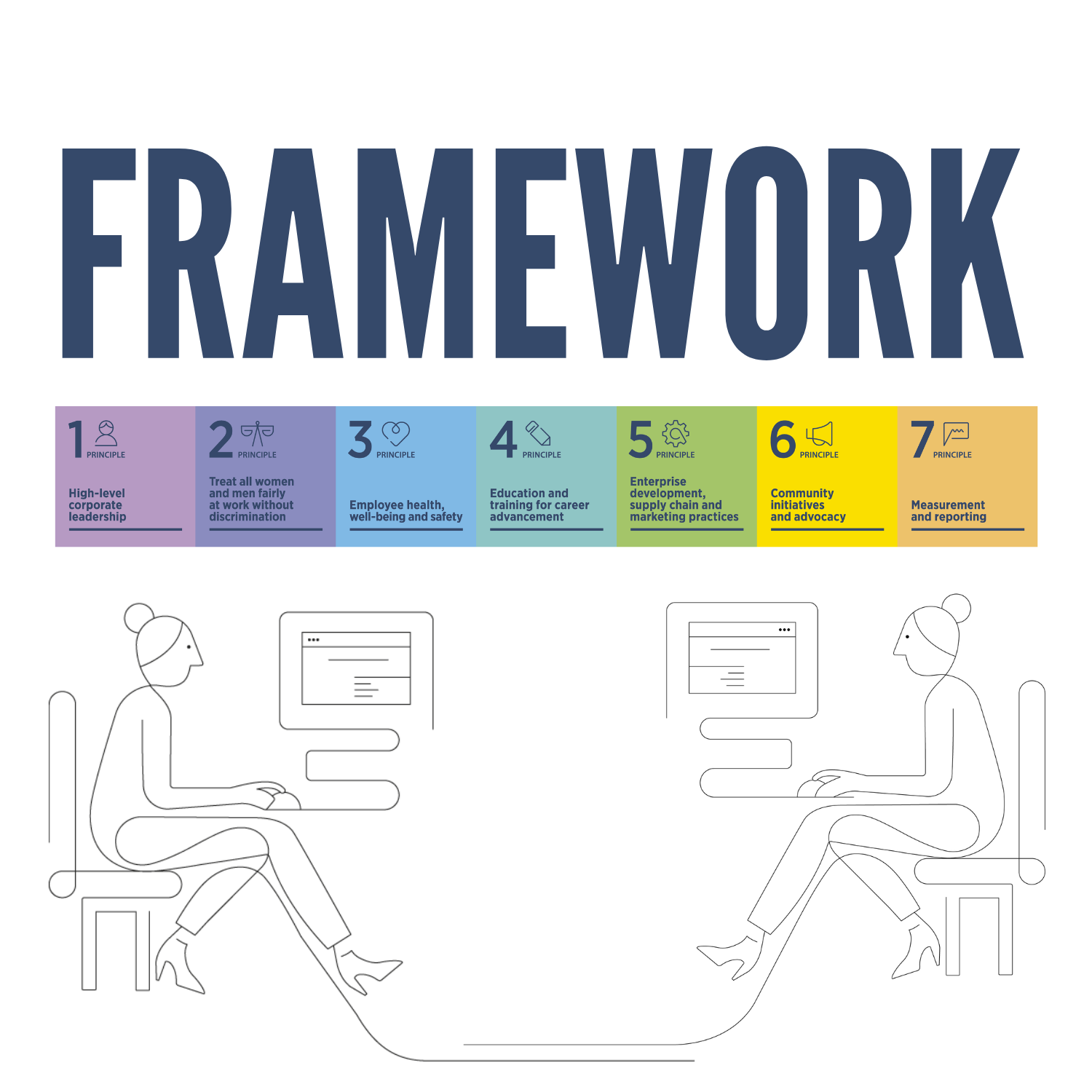
The WEPs provide a comprehensive framework for advancing gender equality across a company’s operations and value chain. Grounded in international labour and human rights standards, the seven Principles help companies embed gender equality into leadership, workplace practices, supply chains, products and services, community engagement, and measurement and reporting.
Companies themselves identify this framework as one of the strongest benefits of joining the WEPs. In the 2025 WEPs Global Survey, 76% of respondents said they joined to align with global good practices, while 42% identified the WEPs as their overarching strategic framework for gender equality.
Working with partnerships and collaboration, the WEPs have also helped shape the wider ecosystem of corporate gender equality standards, tools and initiatives. They have informed guidance developed by the UN Sustainable Stock Exchanges (SSE) initiative and inspired corporate assessment methodologies such as the Equileap Gender Scorecard, which also recognizes WEPs signatory status. The WEPs has also influenced national programmes such as the Jordan Gender Seal and are increasingly being referenced in responsible business conduct, corporate reporting and procurement initiatives.
 The WEPs bring together more than 13,000 companies and business networks committed to advancing gender equality, creating opportunities to learn from one another and act together.
Through peer exchanges, events, workshops, case studies and thought leadership, signatories can share experience, learn what works (and doesn’t) and collaborate with companies confronting similar challenges across industries and markets.
This global community is itself a major reason companies join: in the 2025 Global Survey, 69% of respondents identified becoming part of a network of like-minded companies as one of their motivations.
 The WEPs offer practical tools, guidance and learning opportunities to help companies understand where they stand, identify priorities, develop action plans, measure progress and strengthen accountability.
Companies consistently identify implementation support as one of their greatest needs, particularly when moving from high-level commitments to concrete and measurable action. As one company explained:
"The most valuable support is guidance on where and how to start, practical tools to assess our situation, templates we can adapt, mentoring to keep us accountable over time."
 Signing the WEPs enables business leaders to make a public commitment to advancing gender equality across their company’s operations and value chain. It signals to employees, investors, customers, business partners and policymakers that the company intends to translate that commitment into action and demonstrate progress.
Evidence suggests that WEPs signatories are more likely to put relevant policies and practices in place. An analysis of 350 leading companies across the G7 found that WEPs signatories performed more strongly than comparable non-signatories across several areas of gender equality and responsible business conduct.
WEPs signatories were more likely to:
✓ Have human rights policies
✓ Achieve greater representation of women in leadership
✓ Publish gender-related performance data
✓ Implement family-friendly workplace policies
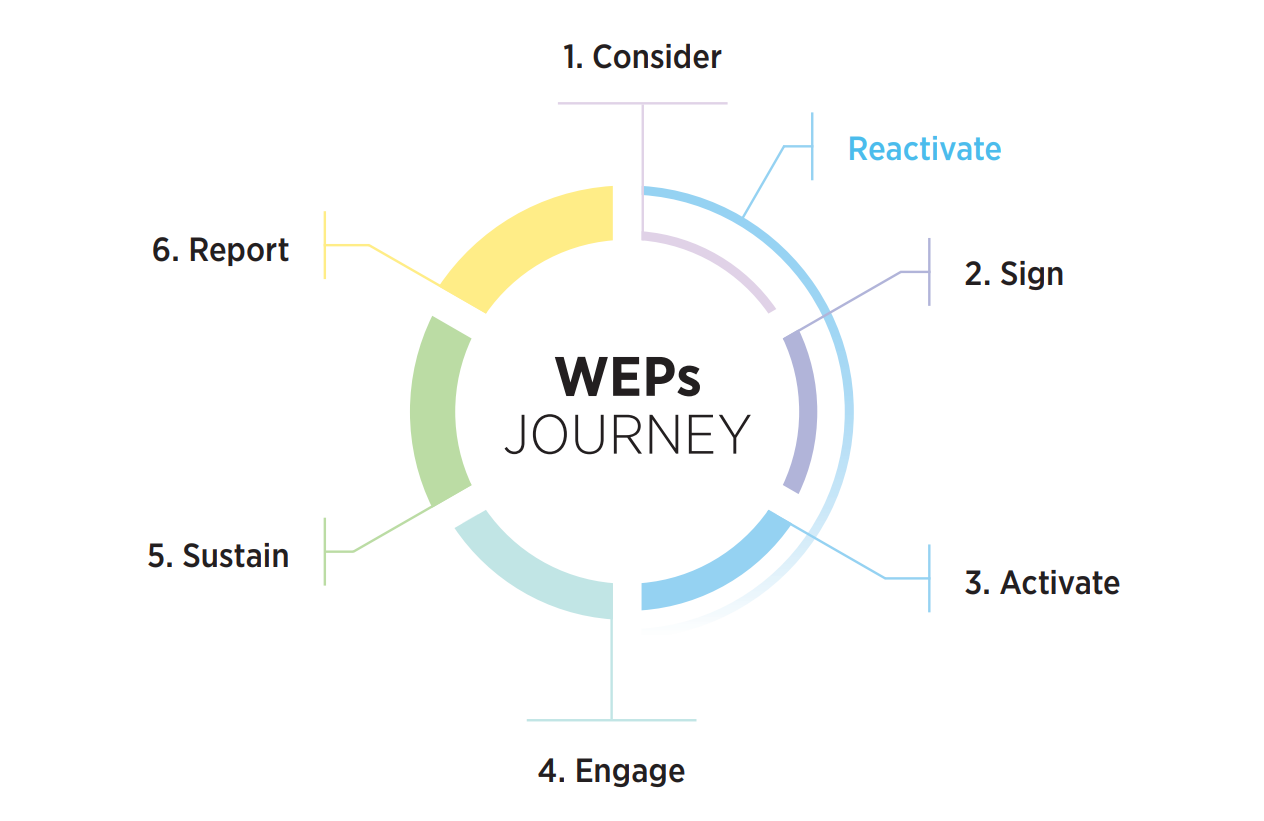
Adopting the WEPs is a continuous journey of six main stages. The Journey guides WEPs signatories through: (1) gathering internal support for signing the WEPs (Consider), (2) collecting information required for a signature (Sign), (3) showing the company commitment to gender equality on the company profile page (EN, JP) and activating internal stakeholders with the help of industry-specific practices and recommendations (Activate), (4) engaging external stakeholders through the value chain (Engage), (5) gathering data against the WEPs Transparency and Accountability Framework (Sustain), and (6) reporting on eight key performance indicators on their WEPs company profile pages (Report). More information about the WEPs Journey can be found in the WEPs Brochure.

WEPs TOOLKIT
Your tools for advancing gender equality in the workplace, marketplace & community
Thematic Guides  Leaders Insights
 Ally Insight
 Action in Crisis
 Public Policies
 Transparency and
accountablity  All about WEPs
 FAQ | How-to's
 Signatories in Action
 Templates
 Multimedia
 WEPs Learn

As WEPs continue to expand, many non-eligible organizations, particularly governments and NGOs, have expressed interest in joining the community due to their ability to influence private-sector operations. To address this, the WEPs Ally Initiative has been introduced to engage and recognize these stakeholders. A WEPs Ally is an entity that, while not eligible to become a signatory, has a proven track record of promoting WEPs and influencing gender equality in the private sector.


