
The Women’s Empowerment Principles (WEPs) were created as a framework for the private sector to advance gender equality and women’s empowerment, recognizing its catalytic role in accelerating women’s economic participation. Since its launch, the WEPs community has grown to over 11,000 CEOs in more than 190 countries, with legally registered companies, chambers of commerce, industry associations, and cooperatives eligible to join.
As WEPs continue to expand, many non-eligible organizations, particularly governments and NGOs, have expressed interest in joining the WEPs community due to their ability to influence private-sector operations. To address this, the WEPs Ally Initiative has been introduced to engage and recognize these stakeholders.
A WEPs Ally is an entity that, while not eligible to become a signatory, has a proven track record of promoting WEPs and influencing gender equality in the private sector. The WEPs Ally initiative provides a structured way for organizations to participate in existing WEPs programmes, reinforcing collaboration between the private sector and other key stakeholders.
Currently being piloted in Bolivia, India, Jordan, Nigeria, Pakistan, and globally, the WEPs Ally Initiative will help expand the WEPs network and strengthen its impact on gender equality globally.
UN Women is excited to Announce Centre for International Studies and Cooperation (CECI) Bolivia as a WEPs ally in Bolivia. Founded in Montréal in 1958 and active in Bolivia since 1990, CECI is a Canadian non‑profit dedicated to building a world without poverty through sustainable, inclusive development. Working in 17 countries across Africa, Asia and the Americas, CECI and its partners co‑create innovative solutions that amplify the power and leadership of women, girls and other marginalized groups. In Bolivia, CECI works on a project to transform ecosystem approach for Women’s Economic Empowerment as a executor together with IES Foundation, a project funded by Global Affairs Canada. This project aims to promote inclusive economic growth for women led micro, small, and medium-sized enterprises of Bolivia.
As a WEPs ally, CECI will co-organize a series of eight WEPs Community sessions in Bolivia with WEPs signatories, each focused on one to two Women’s Empowerment Principles (WEPs), to identify context-specific opportunities and challenges. The sessions aimed to align WEPs implementation with national cultural, legal, and policy frameworks, fostering a locally grounded pathway for gender-responsive business practices. Also, CECI will support systematization of WEPs for small and medium sized companies from Bolivia. Furthermore, CECI will mobilize their global network to raise awareness about the WEPs among their members.
UN Women is pleased to announce Collective Good Foundation and Gender at Work as WEPs Allies, reinforcing its commitment to advancing gender equality and women’s empowerment.
Collective Good Foundation has a track record of impact-driven partnerships to advance gender equality. As a WEPs ally, the Foundation plans to enhance awareness of WEPs through targeted outreach, workshops and advocacy initiatives. The Foundation will be instrumental in supporting capacity-building efforts, driving WEPs implementation in private sector companies, and integrating good and emerging practices into ongoing programmes. Their collective goal is to increase the number of signatories, strengthen gender equality reporting, and establish sustainable systems for accountability and inclusion.
In the months ahead, UN Women will work with Collective Good Foundation and Gender at Work to conduct specialized bootcamps for female students from industrial training institutes and polytechnic institutions in marginalized communities. These bootcamps will focus on equipping the students with industry-relevant skills and connecting them with professional opportunities. Through partnerships with private companies, UN Women aim to facilitate internships and apprenticeships, creating viable employment pathways. The programme will also include sessions on workplace readiness and gender-sensitive practices to foster inclusive work environments. These initiatives will bridge the gap between skilled youth and the private sector, while championing gender diversity in the workforce.
Together, through a joint workplan, the Allies will work towards strengthening gender-responsive business practices, advancing WEPs implementation, and institutionalizing inclusive policies within private companies.
Gender Responsive Procurement Training
On 12 June 2025, UN Women hosted a GRP training for WEPs signatory companies. The session was co-hosted by Priya Naik, Founder & CEO of Collective Good Foundation and Samhita Social Ventures; and Mayank Shah, global expert in supplier diversity and co-founder of Global Supplier Diversity Alliance.
The session brought together 68 participants to enhance their awareness and build their technical capacity on inclusive sourcing practices, providing practical strategies to integrate gender equality into procurement policies and processes.
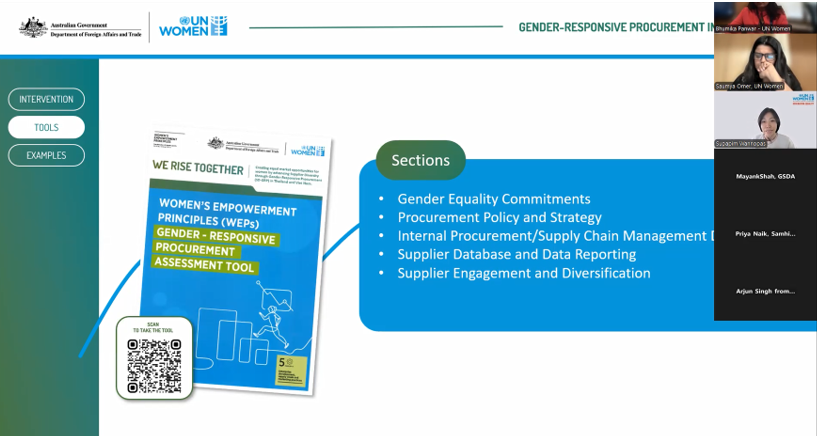
The training also deepened participants’ awareness of the WEPs GRP Assessment Tool, offering step-by-step guidance for companies to evaluate procurement systems through a gender lens. The session enhanced participants’ understanding of GRP concepts and practices and inspired them to strengthen their commitment to gender equality and women’s empowerment beyond the workplace. It marked a crucial step in advancing the WEPs through more inclusive and gender responsive supply chains.
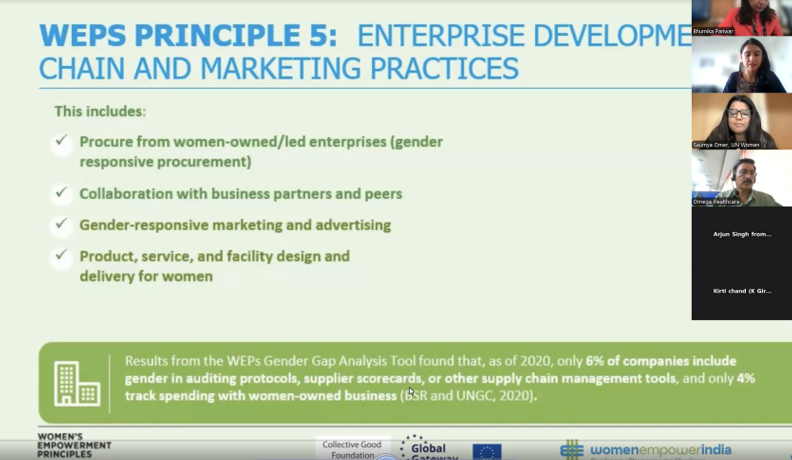
On 4 September 2025, from 3:00–4:30 PM IST, UN Women, in collaboration with IFC and its WEPs ally Gender at Work, organized a training on gender-inclusive hiring with 22 participants. The session was facilitated by Bhumika Panwar, UN Women and Sudarshana Kundu, Managing Director, Gender at Work, and opened with an introduction to the Women’s Empowerment Principles (WEPs) to set the context for why inclusive hiring is critical in advancing workplace equality. Participants explored how unconscious and gender biases surface across the hiring cycle—from job descriptions and sourcing to shortlisting, interviews, and final selection. Case studies and interactive exercises encouraged reflection on stereotypes, such as men being perceived as natural leaders while women are limited to care-related roles, and how these perceptions undermine fair recruitment and career progression.
A central highlight was the introduction of the HQ Checklist on Recruitment, which provided concrete steps to embed equity in hiring. The session emphasized that inclusive hiring is not merely a procedural adjustment but a strategic priority that strengthens talent pipelines, fosters inclusive organizational culture, and enhances competitiveness. Participants left with practical tools and heightened awareness to de-bias recruitment processes and integrate gender inclusion more effectively into their organizations.
UN Women is proud to welcome the Jordanian National Commission for Women (JNCW) as a WEPs Ally, reinforcing its enduring leadership in advancing gender equality and women’s empowerment in Jordan. As the country’s leading authority on women’s issues—chaired by Her Highness Princess Basma bint Talal, UN Women’s Goodwill Ambassador to Jordan—JNCW is a vital strategic partner in placing gender equality at the heart of Jordan’s national development.
Through its National Strategy for Women (2020–2025) and Action Plan (2023–2025), JNCW is driving transformative change across multiple fronts—from reforming labor laws and promoting women’s participation in the formal economy, to expanding access to finance, supporting women entrepreneurs, and advancing gender-responsive policies. The strategy also prioritizes political participation, combating gender-based violence, and institutionalizing gender mainstreaming in both the public and private sectors.
As a WEPs Ally, JNCW will champion women’s economic empowerment within the private sector, promote the Women’s Empowerment Principles (WEPs) among companies and stakeholders, and support businesses in embedding gender-responsive policies and practices. JNCW will also play a key role in fostering partnerships across sectors to maximize the impact of the WEPs in Jordan.
JNCW has long served as Jordan’s national women’s machinery—and was the first of its kind in the Arab region—building bridges between government, civil society, and the private sector to ensure women’s voices shape the country’s future.
UN Women looks forward to deepening our collaboration with JNCW to create more inclusive, equitable workplaces and unlock the full potential of women in Jordan’s economy.
UN Women is pleased to announce Zamani Foundation as a WEPs Ally, reinforcing its commitment to advancing gender equality and women’s empowerment. As a WEPs ally, Zamani Foundation will actively promote the WEPs among businesses and stakeholders through targeted capacity-building initiatives.
These efforts will include organizing quarterly workshops and webinars, distributing educational materials such as toolkits and case studies, and collaborating with thought leaders on public awareness campaigns. The foundation aims to increase knowledge by driving 10% growth in event attendance compared to 2024. Additionally, Zamani Foundation will engage in policy advocacy to align corporate practices with national frameworks. This will involve drafting workplace equality recommendations and hosting leadership roundtables, with the objective of influencing at least two new policies in key sectors.
To strengthen and expand the WEPs network, Zamani Foundation will lead initiatives such as the WEPs ally activities, regional committees, and referral programs. These efforts aim to drive a 20% increase in membership while maintaining retention rates above 85%, ensuring a thriving and engaged community of WEPs Allies.
UN Women is pleased to announce the Pakistan Business Council (PBC) as a WEPs Ally, promoting the adoption of the WEPs within Pakistan’s business community. Leveraging its extensive network of 95 leading businesses and its strong reputation as a platform for business policy advocacy, the PBC seeks to drive meaningful progress toward gender equality in the corporate sector through its Centre of Excellence in Responsible Business (CERB).
The PBC plays a pivotal role in fostering dialogue, building awareness, and supporting companies in integrating WEPs into their organizational frameworks. In alignment with UN Women’s WEPs Allies' initiative, the PBC actively promotes gender equality by encouraging more businesses to become WEPs signatories, extending WEPs principles into supply chains, and co-organizing capacity-building activities. Kicking off its ally ship with a workshop on signing up to the WEPs, CERB invited UN Women to guide Pakistani companies on the next steps.
By partnering with UN Women, the PBC strengthens its commitment to creating an inclusive corporate ecosystem where businesses not only recognize but also act upon their responsibility to advance women’s economic empowerment. Through structured engagements, knowledge-sharing, and collaborative efforts, the PBC aims to enhance private sector accountability and drive systemic change in Pakistan’s business landscape.
UN Women is pleased to announce the Watch & Jewellery Initiative 2030 (WJI 2030) as a WEPs ally. Co-founded by Cartier and Kering, proudly reaffirms its steadfast commitment to gender equality and women’s empowerment by actively supporting the Women’s Empowerment Principles (WEPs). This commitment is a reflection of our core values, driving our mission to create a more inclusive and equitable industry.
By aligning with the WEPs, we are leveraging a powerful framework developed by UN Women and the UN Global Compact to drive meaningful change. Rather than reinventing the wheel, we build upon these established principles to create lasting impact across the watch and jewelry value chain. As a minimum commitment, WJI 2030 asks all member companies to commit and become signatories of the WEPs.
In 2022, WJI 2030 and WEPs consolidated its partnership and have since then embarked on numerous collaborative projects to advance gender equality, as well as uptake and implementation of the WEPs, in the global watch and jewelry sector. We aim to move from activation to acceleration, ensuring that our initiatives not only take root but thrive.