
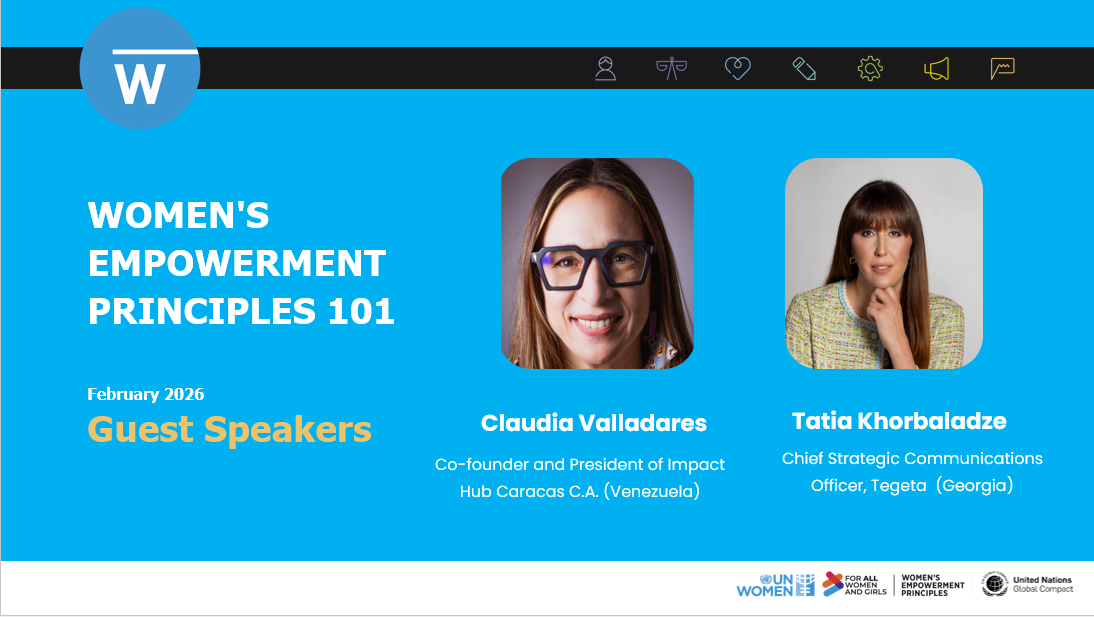
On 4 February 2026, UN Women and the UN Global Compact co-hosted a global WEPs 101 webinars, introducing companies and interested parties to the Women’s Empowerment Principles (WEPs) and their practical application across leadership, workplace culture, supply chains, and community engagement.
Two business leaders brought the Women’s Empowerment Principles (WEPs) to life with practical examples from their organizations and communities: Tatia Khorbaladze, Chief Communications Officer at Tegeta Motors, an automotive company operating out of Georgia, and Claudia Valladares, Co-founder and CEO of Impact Hub Caracas (Venezuela), which works on building inclusive entrepreneurship systems.
This blog summarizes the key insights and takeaways from the discussion. The full recording of the webinar is available here.
Both companies joined the WEPs for practical, strategic reasons
For Impact Hub Caracas, the WEPs aligned directly with their mission and theory of change. Signing provided a structured way to embed gender equality across their operations, programmes, and entrepreneur ecosystem. It gave them a recognized framework to strengthen what they were already doing and to scale it more intentionally.
For Tegeta, operating in a traditionally male-dominated automotive sector, signing the WEPs in 2022 was a deliberate move to challenge industry norms and expand opportunities for women at all levels of the company. The WEPs provided access to UN Women expertise, a clear framework and internal leverage and credibility to anchor discussions with leadership.
As Tatia described, the Women’s Empowerment Principles gave the team the backing they needed to run more structural projects, informed by research into women’s needs in Georgia and feedback from women and men in the company.
Their commitment and action has paid off: At Tegeta, women’s representation in top management increased by 11 per cent since signing the WEPs and implementing various programmes. The company also marked a historic milestone: for the first time in 30 years, a woman became CEO in the automotive sector in Georgia. Impact Hub Caracas is also entirely women-led, in a country where only 2 per cent of CEOs are women.
Reshaping the pipeline, workplace culture and care norms
However, gender equality in leadership does not begin in the boardroom. It requires structural investment across the pipeline, within work culture and across supply chains.
Tegeta expanded access to non-traditional careers by funding training programmes for women mechanics and redesigning workplace facilities to support their inclusion. What began as a pilot grew year by year, steadily changing perceptions in a male-dominated industry. Impact Hub Caracas worked upstream, engaging girls and young women in STEM, technology and entrepreneurship. Through school programmes reaching more than 42,000 students annually, they are tackling stereotypes before they become structural barriers.
Both organizations implemented zero-tolerance policies on violence and harassment, and followed them up with concrete actions. Impact Hub Caracas requires members to commit to zero tolerance for violence and harassment and supports this with an ethical committee to ensure accountability. At Tegeta, awareness campaigns and internal trainings revealed that many employees did not fully understand what constitutes harassment. Rather than assuming knowledge, the company initiated open conversations, including sessions specifically designed to engage men. Over 200 employees participated in trainings, with overwhelmingly positive feedback.
Another clear area where Tegeta engaged men for gender equality was in encouraging fathers to take leave signalling that care is not a women’s responsibility alone.
Extending equality beyond company walls
Impact Hub Caracas applies a gender lens across its full ecosystem — from inclusive language in marketing to supplier selection. When possible, they prioritize women-led businesses in procurement. Tegeta similarly works to influence suppliers, particularly smaller local businesses that may not yet have formal ESG guidelines. By modelling inclusive practices, they aim to shift expectations across the value chain.
Both companies publish or communicate their impact publicly, reinforcing transparency and accountability.
Core recommendations for companies considering WEPs
The webinar closed with practical guidance drawn from lived experience.
- Start small — but start. Many impactful initiatives began as modest projects: a training session, a policy update, a pilot programme. Momentum builds over time and making progress is a journey
- Make policies live. Signing and drafting documents is only the beginning. Real change happens when employees understand why policies[AF1] matter and how they affect daily work.
- Engage men. Gender equality is not a women-only conversation or issue. Cultural shifts require inclusive dialogue.
- Use WEPs as a framework and a community. The Principles offer structure, but equally important is peer learning. Companies learn faster when they exchange good practices and adapt what works.
- And finally, recognize that gender equality is strategic. As highlighted in the webinar’s closing reflections, overlooking gender dynamics creates blind spots — particularly in times of economic and social disruption. Embedding equality into governance, workplace culture, procurement and community engagement strengthens resilience and long-term competitiveness.
The stories from Georgia and Venezuela made one thing clear: implementing the WEPs is not about achieving perfection overnight. It is about consistent progress — translating commitment into systems, and systems into culture.