
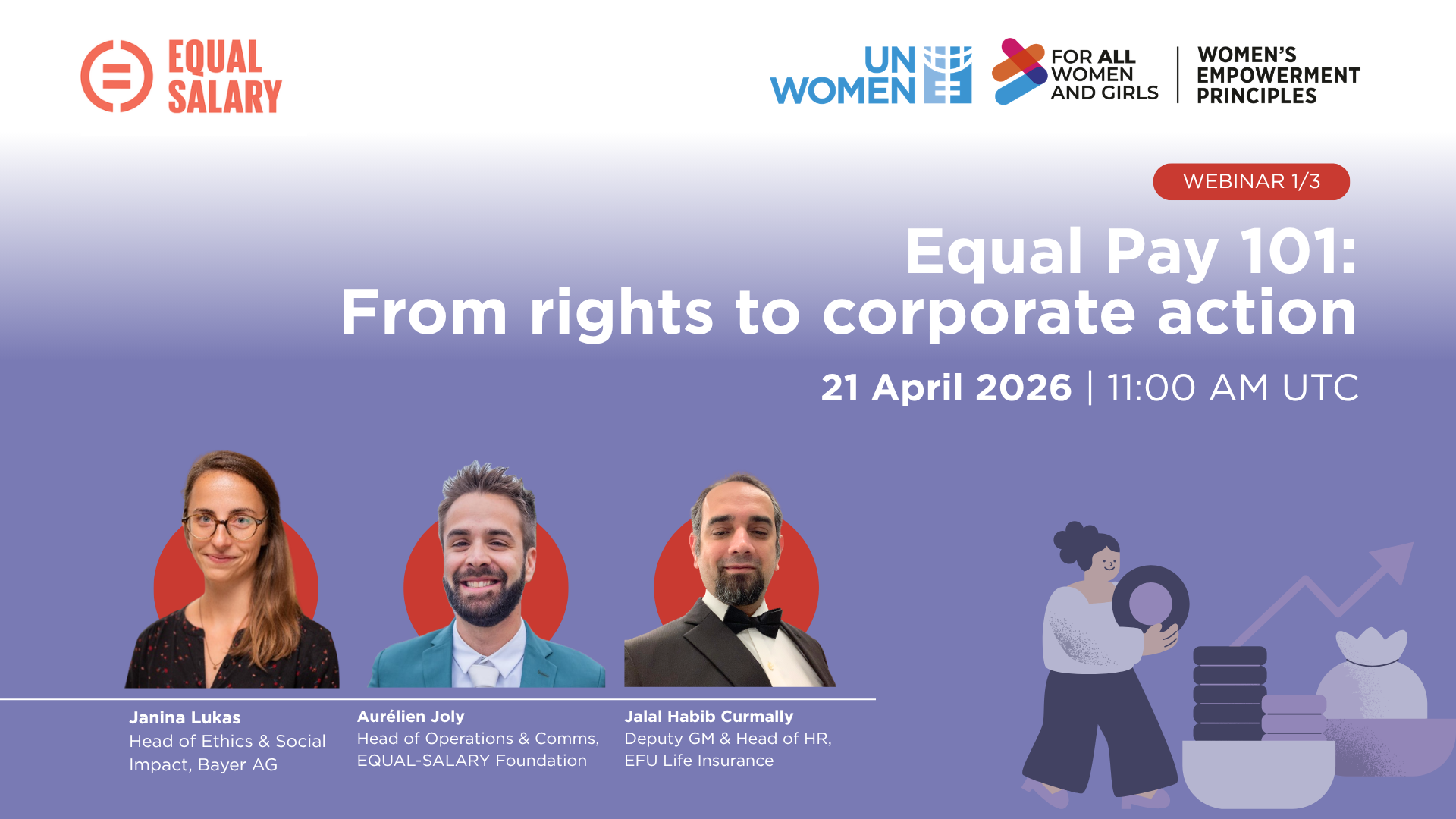
The first session of the Equal Pay webinar series, co-organized by the Women's Empowerment Principles Global Secretariat and EQUAL-SALARY Foundation brought together Anna Falth (WEPs), Aurélien Joly (EQUAL-SALARY Foundation), Janina Lukas (Bayer) and Jalal H. Curmally (EFU Life Insurance) to move the conversation from commitment to action on equal pay.
Equal pay for work of equal value is widely recognized as a fundamental human right. And yet, despite decades of progress, gender pay gaps persist globally at around 20%. For companies, the conversation has evolved. Equal pay is no longer framed only as a question of fairness or compliance—it is increasingly understood as a matter of governance, performance, and long-term business resilience.
At a basic level, most organizations are familiar with the idea of equal pay: women and men should be paid the same for the same work.
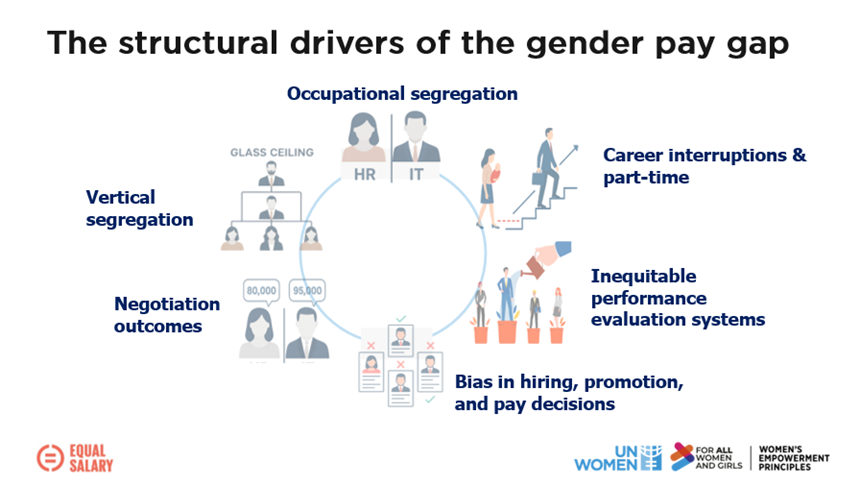
But the more complex question is one of pay equity. Are different roles, requiring comparable levels of skill, effort, and responsibility, valued equally across the organization? It is here that deeper structural inequalities tend to emerge.
A recent conversation between two WEPs Signatories shows that there is no single path to achieving equal pay, but there are clear patterns in what works.
For Bayer, the journey began not with data, but with governance. Years before conducting detailed pay gap analyses, the company had already formalized its approach to fairness through a human rights policy and a commitment to non-discrimination. Introducing a living wage framework helped the organization better understand its own salary structures. Only then did the company begin to ask a more challenging question: if these systems are working as intended, what does the data actually show?
That shift—from assuming fairness to testing it—marked an important turning point. It required building internal methodologies to measure pay gaps from scratch, bringing together expertise from human resources, data science, and compensation teams. Measurement did not come as a quick fix, but as a natural next step in a broader effort to embed fairness into how the organization operates.
At EFU Life Insurances journey was different, the starting point looked different. Rather than beginning with formal analysis, the company focused on embedding fairness into everyday decision-making. Recruitment, promotion, and compensation processes were designed to be gender-agnostic, guided by a strong internal principle: merit should be the only differentiator. Over time, this approach was reinforced through better data systems and dashboards, allowing the company to track outcomes more systematically.
What stands out is that neither company treated equal pay as a standalone initiative. In both cases, it became part of how the business functions—integrated into governance, culture, and operational processes.
Progress, however, did not happen all at once. It was shaped by a series of moments that shifted direction and momentum.
For Bayer, one of those moments came when the organization moved from policies to measurable analysis. The introduction of structured pay equity reviews across countries, supported by new tools and methodologies, allowed the company identify concrete areas for action. Interestingly, the analysis did not reveal large systemic issues—but it still played a critical role in validating systems and guiding continuous improvement.
At EFU Life Insurance, a different kind of milestone proved equally transformative: the promotion of women into senior leadership roles. This was not only symbolic. It directly signaled new expectations about career progression within the organization. Representation, in this sense, became a lever for pay equity.
Some of the most effective changes, however, were also the simplest. One example was the decision at EFU Life Insurance to ensure that candidate shortlists consistently included qualified women. This did not lower standards or introduce quotas—it simply changed who was considered. Over time, this small adjustment reshaped hiring patterns, even in departments that had historically been resistant to change.
These experiences point to a broader lesson: equal pay is not achieved through one major intervention, but through a series of consistent, intentional actions.
They also highlight the challenges companies inevitably face along the way. One of the most significant barriers is not technical, but cultural. The moment companies begin to measure pay gaps, resistance can emerge. Managers may feel exposed or assume that the data reflects individual failure. In reality, pay gaps are rarely the result of a single decision; they are the cumulative outcome of many small choices over time.
The companies that move forward are those that are able to reframe this moment—not as a question of blame, but as an opportunity to improve. An open mindset becomes essential. Without it, even the most sophisticated analysis will struggle to translate into meaningful change.
For companies at earlier stages, the message is not to wait for perfect conditions. Starting the process—however simple—is often the most important step.
Even basic data, if used thoughtfully, can begin to reveal patterns and prompt new questions. From there, progress becomes a matter of iteration: assessing, adjusting, and improving over time.
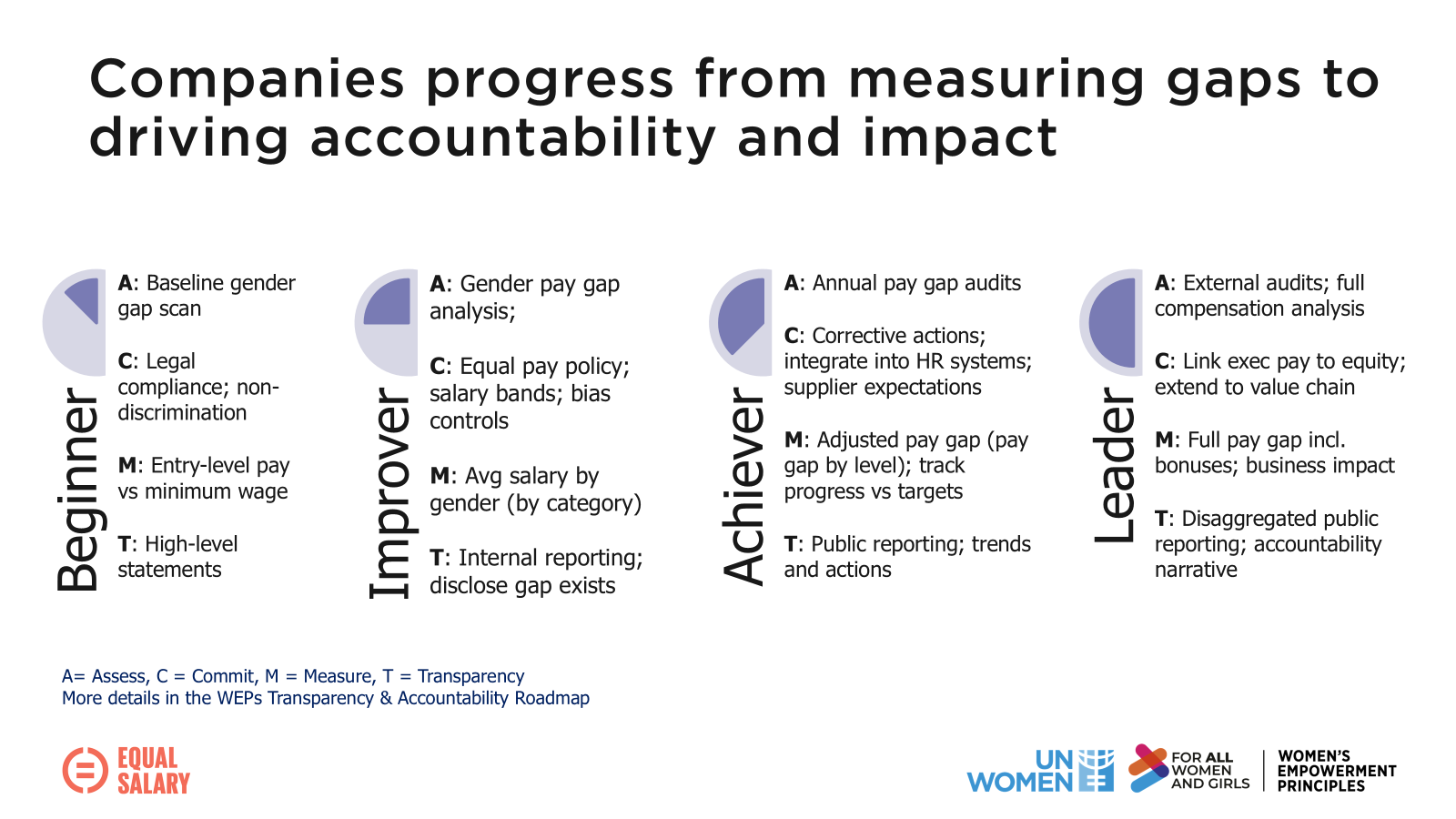
Ultimately, what these experiences make clear is that equal pay is not a one-off exercise. It is a journey that requires persistence, alignment, and a willingness to confront uncomfortable truths. But it is also a powerful entry point for broader change.
When companies begin to address pay equity, they are not only closing gaps—they are strengthening trust, improving decision-making, and building more resilient organizations.
And perhaps most importantly, they are demonstrating that fairness is not just a principle, but a practice.
See WEPs Resources
- WEPs Guidance Note: Closing Gender Pay Gaps to Achieve Gender Equality at Work | WEPs
- WEPs Action Card - Closing Gender Pay Gaps | WEPs