
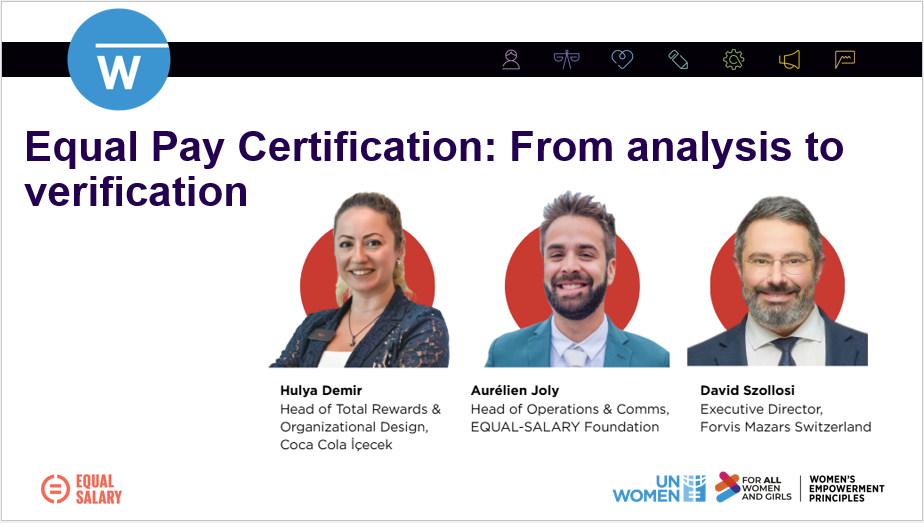
Organizations increasingly face expectations from employees, regulators, investors, and society to demonstrate that their commitment to gender equality is producing measurable results. During this webinar organized by the UN Women WEPs Secretariat and the EQUAL-SALARY Foundation on 30 June 2026, experts shared practical guidance on equal pay certification, highlighting how organizations can strengthen accountability, improve governance, and embed pay equity into everyday business decisions.
See the recording of the Webinar here
Speakers
- Anna Falth, Head of the Women's Empowerment Principles Secretariat, UN Women
- Aurélien Joly, Head of Operations and Communications, EQUAL-SALARY Foundation
- Hulya Demir, Head of Total Rewards and Organizational Design, Coca-Cola İçecek (CCI)
- David Szollosi, Executive Director, Forvis Mazars Switzerland
Why Equal Pay Certification Matters
The discussion began with a broader reflection on the evolving expectations surrounding pay equity. Equal pay is no longer solely a compliance issue – customers, employees, business partners and investors increasingly want evidence that organizations are identifying and addressing unjustified pay differences.
Anna Falth highlighted that certification helps organizations move beyond intentions and policies toward accountability and trust. Whether organizations pursue certification or not, the underlying objective remains the same: understanding workforce data, identifying unexplained pay gaps, and creating systems that ensure fairness over time.
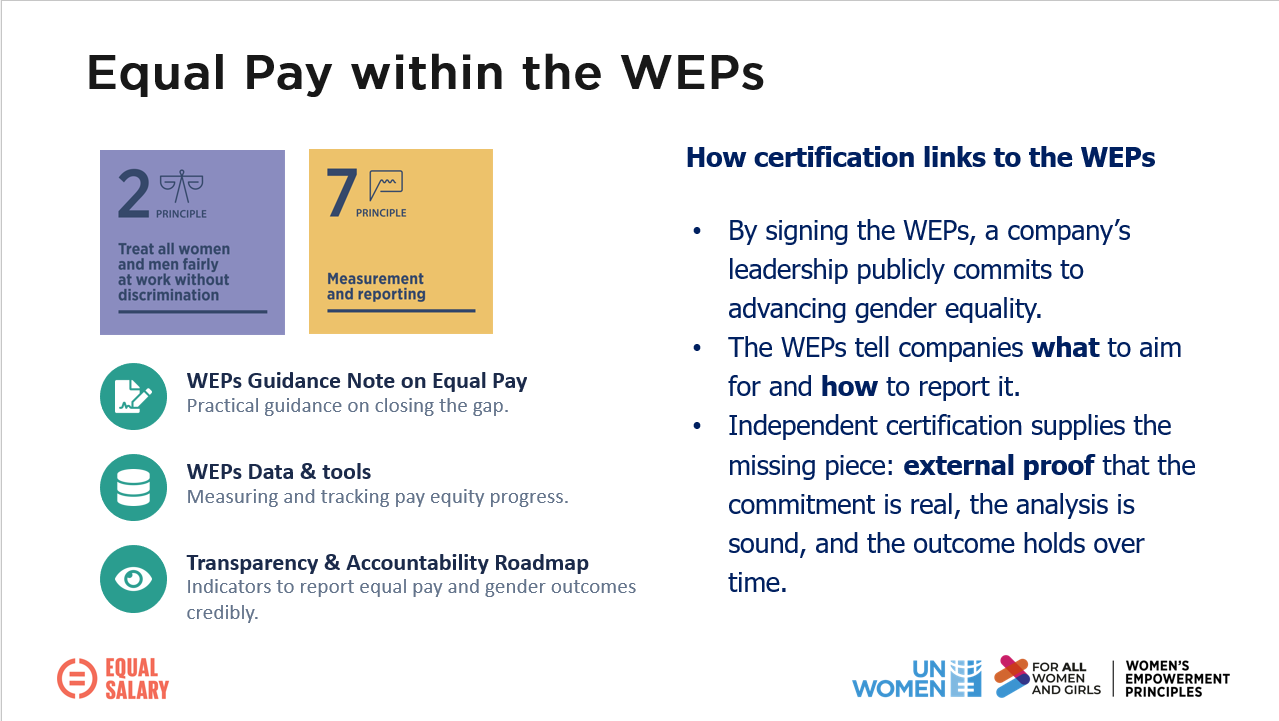
The webinar positioned certification as part of a broader gender equality journey. Organizations typically begin with commitments and policies, then move toward measurement and reporting, before ultimately seeking independent verification of their efforts. Linking it to the WEPs Principles, this is closely aligned with WEPs 2 and WEPs 7; and we know from our Global WEPs Survey that 27% of companies have undergone independent gender equality audit or certification.
What Makes a Certification Credible?
Aurélien Joly from the EQUAL-SALARY Foundation explained that multiple equal pay certifications exist globally, but organizations should focus on the strength of the methodology rather than on branding.
Five elements were identified as critical for credible certification:
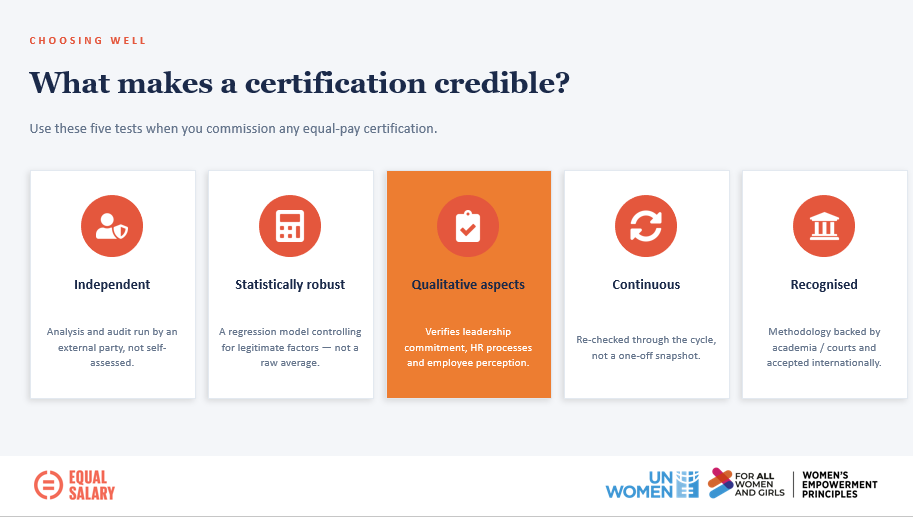
A recurring theme throughout the session was that certification should not be viewed as a one-time exercise. Maintaining equal pay requires continuous monitoring as organizations evolve, hire new employees, promote talent, and adjust compensation structures.
The Certification Process in Practice
The speakers outlined a typical certification journey, beginning with data preparation and scope definition. Organizations must ensure that job information, pay records, and organizational structures are sufficiently robust for analysis.
According to Aurélien Joly, statistical analysis generally focuses on identifying unexplained gender pay gaps after accounting for legitimate factors such as job level, experience, function, and location. The objective is not to eliminate every salary difference but to ensure that gender itself does not explain compensation outcomes.
Certification processes also include qualitative assessments. Auditors review leadership commitment, recruitment and promotion practices, compensation governance, communication processes, and employee perceptions. These assessments help determine whether pay equity is embedded within organizational systems rather than dependent on isolated interventions.
Lessons from Coca-Cola İçecek's Certification Journey
Hulya Demir shared Coca-Cola İçecek's experience implementing equal pay certification, through the EQUAL-SALARY certification, across operations spanning multiple countries.
The company began its gender equality journey through a series of foundational initiatives, including signing the Women's Empowerment Principles in 2015 which became their guiding framework. In 2015, they established a human rights policy, introducing inclusive communication practices, and embedding gender equality objectives into broader sustainability commitments, working on unconscious bias, and making a pledge to work towards the SDGs.
According to Demir, the WEPs were the initiator in this journey, certification represented the next step in validating these efforts. The organization sought external verification not only to assess its own practices but also to serve as a pioneering example across several countries where certification had not previously been achieved.
This is echoed in many other companies, as David Szollosi, who has accompanied over 100 companies in getting and equal salary certification, explains. Companies are constantly evolving, transitioning to fairer and more equal processes is quite a complex change process – an external auditor can help you to identify whether your company is going into the right direction and how to communicate this both internally and externally.
She noted several challenges, particularly around data collection, stakeholder alignment, communication, and building awareness of pay equity concepts across the organization. Strong CEO and leadership support proved essential in maintaining momentum and embedding equal pay principles within company culture.
The Business Value of Equal Pay Certification
The session highlighted multiple benefits from the certification process.
Coca-Cola İçecek observed improved employee engagement and stronger perceptions of fairness and recognition.
Certification also helped reinforce organizational culture by increasing awareness of equality and fairness principles throughout the workforce.
David Szollosi outlined how the certification process includes both an analytical component, as well as a qualitative – conversational – component. Through the process, many teams are able to distinguish what direct actions HR can take, but also what actions need to be taken by other people in order to affect change within an organization. He further emphasized that certification prepares organizations for growing transparency and reporting requirements.
Companies that begin building strong systems today are likely to be better positioned for future regulations and stakeholder scrutiny.
Five Action Recommendations for Companies
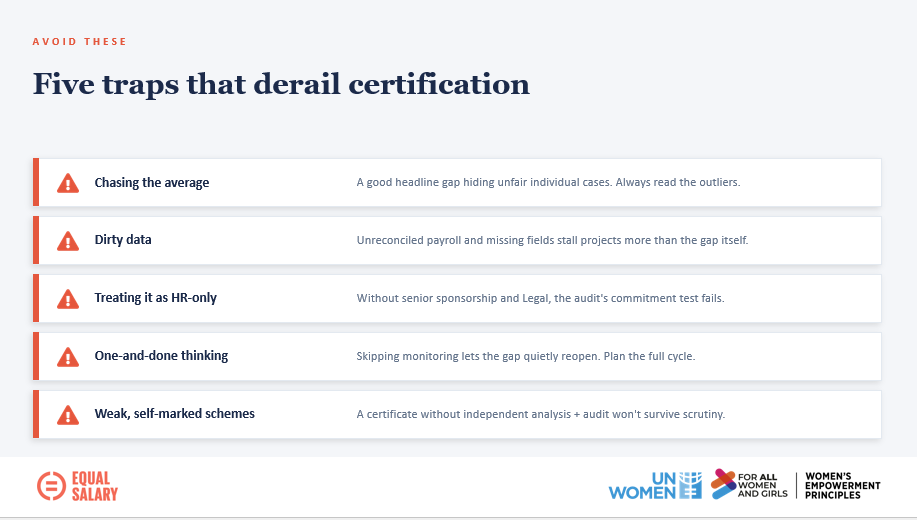
- Assess workforce data quality before launching any pay equity initiative.
- Secure visible executive sponsorship, particularly from senior leadership and CEOs.
- Treat pay equity as a business priority, not solely an HR project.
- Document policies and decision-making processes to ensure consistency and accountability.
- Establish ongoing monitoring mechanisms so that pay equity remains embedded as the organization evolves.
The webinar concluded with a reminder that equal pay is a journey of continuous improvement. Certification is not an endpoint but rather a tool that helps organizations strengthen transparency, accountability, and trust while advancing gender equality in meaningful and measurable ways.