
Every July, government leaders, UN officials and civil society converge on New York for the HLPF to take stock of the SDGs. This year, UN Women used the moment to accelerate progress on one of the clearest opportunities on the table: global supply chains, and the millions of workers within them.
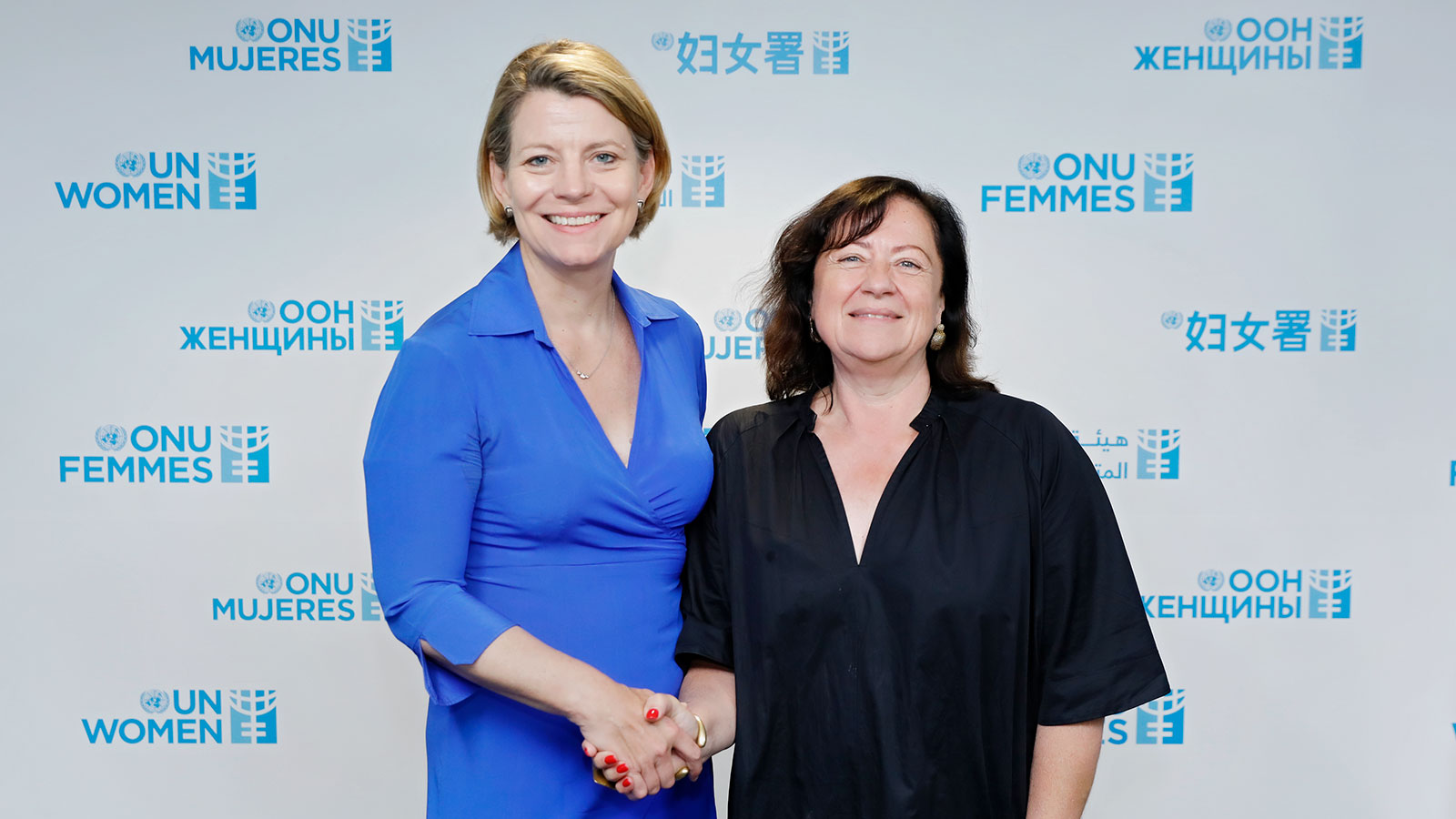
Photo: Megan Gilgan, UN Women (L) with Dr Bärbel Kofler, Parliamentary State Secretary, Federal Ministry of Economic Cooperation and Development Germany (R) | UN Women / Ryan Brown
The UN High Level Political Forum on Sustainable Development (HLPF) is the United Nations' main platform for reviewing progress on the 2030 Agenda and its 17 Sustainable Development Goals (SDGs). Held annually under the auspices of ECOSOC, it brings together governments, UN agencies, civil society and businesses to take stock of what is working, what is not, and where the world needs to accelerate action ahead of the 2030 deadline.
At a moment when multilateral cooperation can feel fragile, the HLPF is one of the few recurring spaces where Member States and other actors sit down together to assess shared goals and coordinate a path forward. It's a chance to reaffirm that global challenges still need global solutions.
This year's forum took a deliberately integrated view, recognizing that the SDGs are interlinked rather than siloed. The 2026 HLPF conducted in-depth reviews of five goals:
- SDG 6 - Clean water and sanitation for all
- SDG 7 - Affordable, reliable and sustainable energy
- SDG 9 - Resilient infrastructure, inclusive industrialization and innovation
- SDG 11 - Inclusive, safe and sustainable cities
- SDG 17 - Stronger partnerships to implement the SDGs
These five goals share a common thread: they are all built and delivered through supply chains: the workers, suppliers and infrastructure that get water flowing, power grids running, cities functioning and industries operating.
Gender equality is central to making that delivery work in a just and sustainable way:
- Water and sanitation (SDG 6): Gender-equal utility and infrastructure workforces help ensure safety, dignity, and more sustainable water and waste systems for the communities they serve.
- Energy (SDG 7): As the energy transition accelerates, embedding gender equality in energy supply chains and green jobs is what makes that transition just, not just fast.
- Cities and industry (SDG 9 & 11): Enormous numbers of people work within global supply chains. Protecting and empowering these workers – especially women – supports the safety and prosperity of the communities and cities they live in.
Resilient infrastructure, energy systems, or cities depend on a resilient, protected workforce behind them.
UN Women’s Global Supply Chain Coalition (GSCC) gives companies a coordinated framework and platform for advancing gender equality across their supply chains: turning individual commitments into collective, industry-wide standards.
That case came into sharp focus on 14 July, when the governments of Croatia and Germany joined UN Women to co-host a high-level roundtable on advancing gender equality in global supply chains on the margins of the HLPF. The event formally welcomed German Parliamentary State Secretary Dr. Bärbel Kofler as patron of the GSCC, and brought together government officials, businesses, civil society and international organizations to discuss how to turn commitment into practice.
The business case, participants agreed, is no longer in question. Companies pursuing strong gender equality strategies deliver higher annual returns than their less diverse peers; in emerging markets, more gender-equal boards see a 2.4 times higher return on investment, and companies in the top quartile for gender-equal executive teams are 25% more likely to outperform their peers on profitability. Some estimates put the potential gain from closing gender gaps across supply chains and business at 15–20% of global GDP.
Discussion also turned to what implementation looks like on the ground. Germany's own experience with due diligence legislation has produced a set of practical tools: a Dialogue for Sustainable Textiles (DST) initiative that helps companies meet due diligence requirements, a gender data gap handbook now translated into 14 languages, its national Agency for Business and Economic Development (AWE) that supports companies navigating German and EU rules, and the EU due diligence navigator for partner countries. Participants stressed that peer learning, co-creation and continuous measurement matter as much as the tools themselves.
Business representatives described how they were putting this into practice: using Environmental, Social and Governance (ESG) platforms and human rights due diligence assessments to identify and validate gender-related risks, benchmarking supply chain diversity against global data, and working with NGOs to close data gaps. But participants also flagged real limits, particularly for small and medium-sized suppliers, who often lack the leverage, resources and data systems of larger firms. Small businesses, several noted, are also disproportionately likely to hire and promote women overlooked elsewhere. This makes their inclusion in supply chain strategies, and in coalitions like the GSCC, especially important, including for female-led micro, small, and medium-sized enterprises in small island developing states.
The roundtable also surfaced calls to bring trade unions more systematically into the Coalition's work, alongside reminders that the policy foundations already exist: SDGs 5, 8 and 10, together with ILO conventions on equal remuneration and non-discrimination, and the EU's own trade and development policies.
The task ahead, participants agreed, is less about writing new commitments than about implementing the ones already on the books, through genuine dialogue with suppliers, especially SMEs, rather than rigid, one-size-fits-all requirements. This is the implementation gap the GSCC is working to fill.
For the GSCC, in practice, that means:
- Embedding gender equality into procurement processes, so supplier requirements, audit criteria and contract terms translate into real workplace protections and career pathways for women.
- Engaging suppliers directly, including lower-tier and informal suppliers that are often invisible in standard due diligence.
- Building shared tools and standards collectively, rather than leaving individual companies, or suppliers, to navigate conflicting demands alone.
- Connecting corporate action to policy dialogue, linking what happens on factory floors and farms to the kind of multilateral conversations happening at forums like the HLPF.
By bringing this work to the HLPF, the GSCC made the case that gender equality in supply chains isn't a side issue: it's key to achieving SDGs 6, 7, 9, 11 and 17, and a practical example of the public-private partnership the SDGs call for under Goal 17.
---
Companies are invited to become members of the Global Supply Chain Coalition, for more information get in touch >