
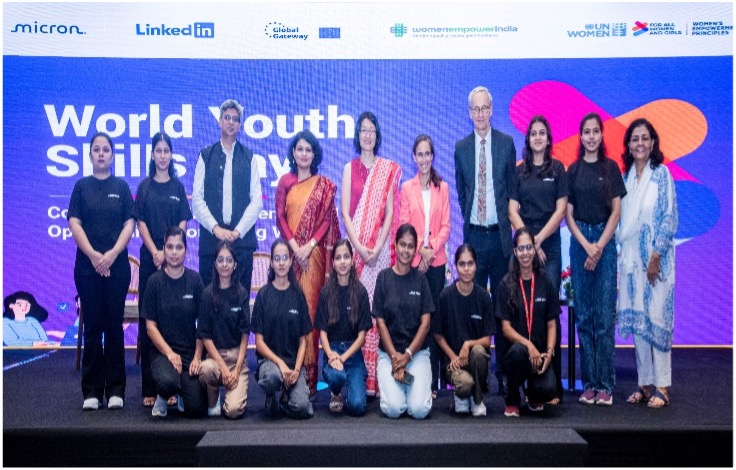
UN Women India convenes government, multilateral, and private-sector leaders — including a CXO-level roundtable with corporate leaders from Women's Empowerment Principles (WEPs) signatory companies — to advance young women's transition from skilling to sustained employment.
NEW DELHI, 17 July 2026 — UN Women India marked World Youth Skills Day 2026 with a full-day convening under the theme "Connecting Skills, Systems and Opportunities for Young Women." The convening served as both a platform for showcasing impact and a forum for forward-looking dialogue, bringing together policy perspectives, industry insights and lived experiences to identify opportunities for strengthening skills, systems and opportunities for young women.
The day began with "Through Her Eyes: Stories of Growth," where young women from the WeSTEM and LinkWomen skilling programmes shared personal accounts of increased confidence, technical exposure, and their transition toward employment.
The inaugural session opened with a welcome address by Ms. Shoko Ishikawa, Country Representative, UN Women, who called for stronger pathways connecting India's growing pipeline of women STEM graduates to decent employment. Special remarks were delivered by Laurent le Danois of the European Union Delegation and Pamela Baijal of the Embassy of the Federal Republic of Germany, who emphasized women's leadership in the green and digital transition.
Government representatives also addressed the event. Manasi Sahay Thakur, Joint Secretary, Ministry of Skill Development and Entrepreneurship, highlighted efforts to strengthen women's participation in India's skilling ecosystem, while Mayank Tewari, Additional Secretary, Ministry of New and Renewable Energy, spoke about the emerging opportunities for women in the renewable energy sector.
This was followed by the panel discussion, "Beyond Enrolment: Strengthening Skills-to-Jobs Pathways with Young Women," moderated by Kanta Singh, Deputy Representative, UN Women. Panellists included Delphine Brissonneau of the European Union Delegation, who highlighted the EU's Women Empower India programme; Mohamed Badran of GIZ's Indo-German Green Skills Programme, who outlined a framework centred on Resources, Representation and Rights; Anand Mali of the Maharashtra State Skill Development Society, who highlighted the state's 50 per cent reservation for women in skilling programmes; and Komila Sharma of the Madhya Pradesh Directorate of Skills Development, who shared the state's progress in increasing female enrolment in Industrial Training Institutes (ITIs) to 23 per cent.
The day concluded with a closed-door CXO Roundtable convened by UN Women India and the Indian Institute of Corporate Affairs (IICA), bringing together leaders from 17 Women's Empowerment Principles (WEPs) signatory companies to advance private-sector action on women's skilling and employment. Opening the session, Ms. Shoko Ishikawa announced a formal UN Women–IICA partnership, while Gyaneshwar Singh, Director General and CEO, IICA, situated the discussion within India's long-term development ambitions.
WEPs signatories discussed opportunities to expand technical skilling, strengthen ITI and training infrastructure, create employment pathways for young women, and advance gender-responsive workplace policies.Five companies also announced commitments to establish solar laboratories, improve ITI infrastructure through sanitary vending machines and smart classrooms, and create employment and internship opportunities for young women.