
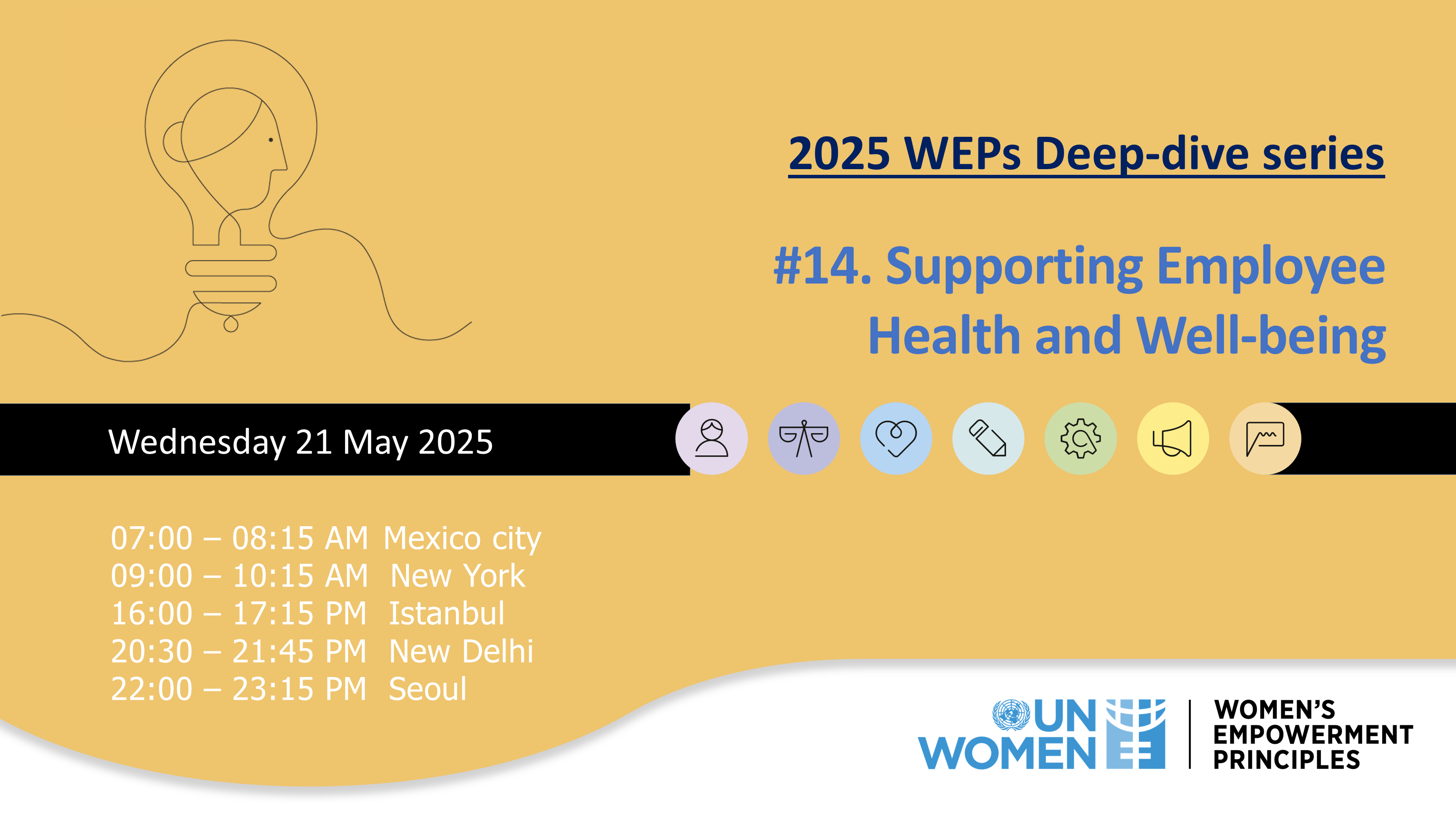
“Women live longer than men,but spend more time in poor health." This powerful statement, made by Anna Falth, Global Head of the WEPs Secretariat at UN Women, set the tone for the 14th session of the Women’s Empowerment Principles (WEPs) webinar series. Hosted by UN Women, the session focused on Principle 3, which calls on companies to ensure the health, safety, and well-being of all employees, with particular attention to women’s needs.
Why Women’s Health in the Workplace Demands Urgent Attention
Women experience disproportionate health burdens, including gender-based violence, mental health challenges, and unsafe working conditions. Their unique health needs—ranging from menstrual health and reproductive care to menopause— are often overlooked in workplace policies.
Anna Falth opened the webinar by reflecting on the persistent challenges women face despite decades of progress since the adoption of the Beijing Declaration and Platform for Action 30 years ago. She emphasized that women’s health is not only a human rights issue but also an economic and business imperative. Anna called for companies to move beyond just ad hoc measures and instead make inclusive health policies standard practice, addressing needs across women’s different life stages.
This call for comprehensive and holistic health policies was echoed in the data shared during the session — data that makes the cost of inaction impossible to ignore.
- A global survey conducted by the Healthcare Businesswomen’s Association (HBA) in partnership with FemTechnology—including over 1,000 women across 42 countries and 6 continents— revealed that 70% of women employees report losing between 1 to 5 days of productivity each month due to women’s health issues. Yet only 10% feel adequately supported by their employers.
- The Deloitte Women @ Work report (2024) echoes this gap. Half of women surveyed reported increased stress levels compared to the previous year—with many working through pain, discomfort, or emotional strain in silence. Without open dialogue or inclusive policies, women are left to manage both physical strain and emotional burden alone — at a cost to their wellbeing, productivity, and career progression.
The Coalition for Reproductive Justice in Business: Why Reproductive Health Belongs in Corporate Strategy
Building on these insights, Mariarosa Cutillo, Chief of the Private Sector and Civil Society Branch at the United Nations Population Fund (UNFPA), presented key findings from an assessment that examined how companies currently address sexual and reproductive health and rights (SRHR)—and where significant gaps still persist. While many firms had initiated programmes on prevention of sexual harassment and maternity leave, the UNFPA research found that companies were not looking into SRHR topics such as menopause, menstrual health and family planning and that existing efforts often lacked comprehensive policies and measurable impact indicators.
In response to these gaps, UNFPA has launched the Coalition for Reproductive Justice in Business, a pioneering initiative working to integrate SRHR into corporate sustainability agendas. Since its inception, the coalition has grown from a small group of advocates to a broad alliance of public and private sector partners. It has focused on developing tools and indicators to help companies track the impact of SRHR programmes and shape inclusive workplace policies. This includes improving conditions for women across supply chains and informal sectors, where over 190 million women are employed globally.
The business case is compelling: the return-on-investment (ROI) tool developed by the coalition revealed that companies investing in SRHR programmes could see up to a 62% reduction in absenteeism, a 22% increase in productivity, along with improved employee engagement and reduced talent attrition.
Real-World Lessons: How WEPs Signatories Are Putting Women’s Well-being First
The case for investing in women’s health is clear—but how are companies translating that into action? Leaders from the jewelry industry shared how they are translating principles into tangible policies that prioritize women’s health and well-being at work.
Valerie Michel, Senior Sustainability Manager at Rosy Blue, an Indian family-owned diamond manufacturer, described the company’s journey toward embedding employee well-being at the heart of their operations. “Your workforce is your greatest asset... making sure they feel well and are healthy and happy at work, that’s the core task of a company,” Valerie explained. With a 15-year commitment to the WEPs, Rosy Blue has focused on building a culture where health, safety, and well-being are central to business success. Operating in contexts like India where only 14% of factory workers are women, the company uses data-driven approaches to navigate cultural and operational challenges.
Holly McHugh, Vice President Sustainability and Social Impact from Mejuri, a women-founded, Canadian jewelry company, echoed this sentiment. With a workforce that is 78% female and predominantly newer to the workforce, she noted that company values are a major driver of retention. “Employees really expect companies to do more than just guarantee healthcare—they want them to really guarantee access also to reproductive care,” Holly shared, referencing a recent Catalyst survey. Mejuri’s response has been to introduce more complete benefits including inclusive parental leave for all parents, regardless of gender or family structure, and to offer flexible return-to-work options.
In the wake of the 2022 Dobbs decision in the United States, Mejuri introduced new benefits—such as ‘no questions asked’ time off, travel reimbursement for healthcare, and expanded bereavement leave—to ensure continued access to care.
Both firms highlighted that proactive policies and visible care for employee well-being drive productivity, trust, and long-term business value.
Small Steps, Big Shifts: Building Momentum for Women’s Health
The webinar underscored that women’s health at work is a multifaceted issue with social, economic, and business implications. Whether through company-specific actions like Mejuri’s flexible policies or Rosy Blue’s efforts to navigate cultural barriers, or through global frameworks like UNFPA’s Coalition for Reproductive Justice in Business, it is evident that meaningful progress is possible.
The speakers provided some guidance on how companies can start making progress:
- Start with employee consultation: Conduct regular consultations and create both formal and informal feedback channels to understand workforce needs. Mejuri demonstrates this with their monthly surveys achieving 78% response rates. While listening is the foundation, it was critical to be prepared to act on what you learn.
- Secure leadership buy-in: Ensure commitment from the highest levels of the company. As UNFPA emphasized, leadership support "trickles down to all dimensions of the company" and transforms women's health from an Human resources initiative into a strategic business priority.
- Embrace ‘crawl, walk, run’: Start small and iterate rather than implementing sweeping changes from the outset. Mejuri began with no-questions-asked time off before expanding to travel reimbursement for healthcare access, preventing costly mistakes from untested large-scale programmes.
- Address cultural context: Understand your specific environment and barriers. Rosy Blue's experience navigating male-dominated industries in India shows the importance of culturally sensitive approaches.
- Set measurable goals and report publicly: Establish clear targets for metrics like retention rates, workforce diversity, and benefit utilization. Mejuri reports progress twice yearly through their website and marketing, demonstrating transparency and accountability.
- Maintain two-way communication: If you cannot immediately address employee requests, provide clear timelines or explanations to prevent initiatives from feeling like employees are "putting ideas into a black hole," as one speaker noted.
You can watch the recording here.