
Shaping a gender-responsive Global Gateway
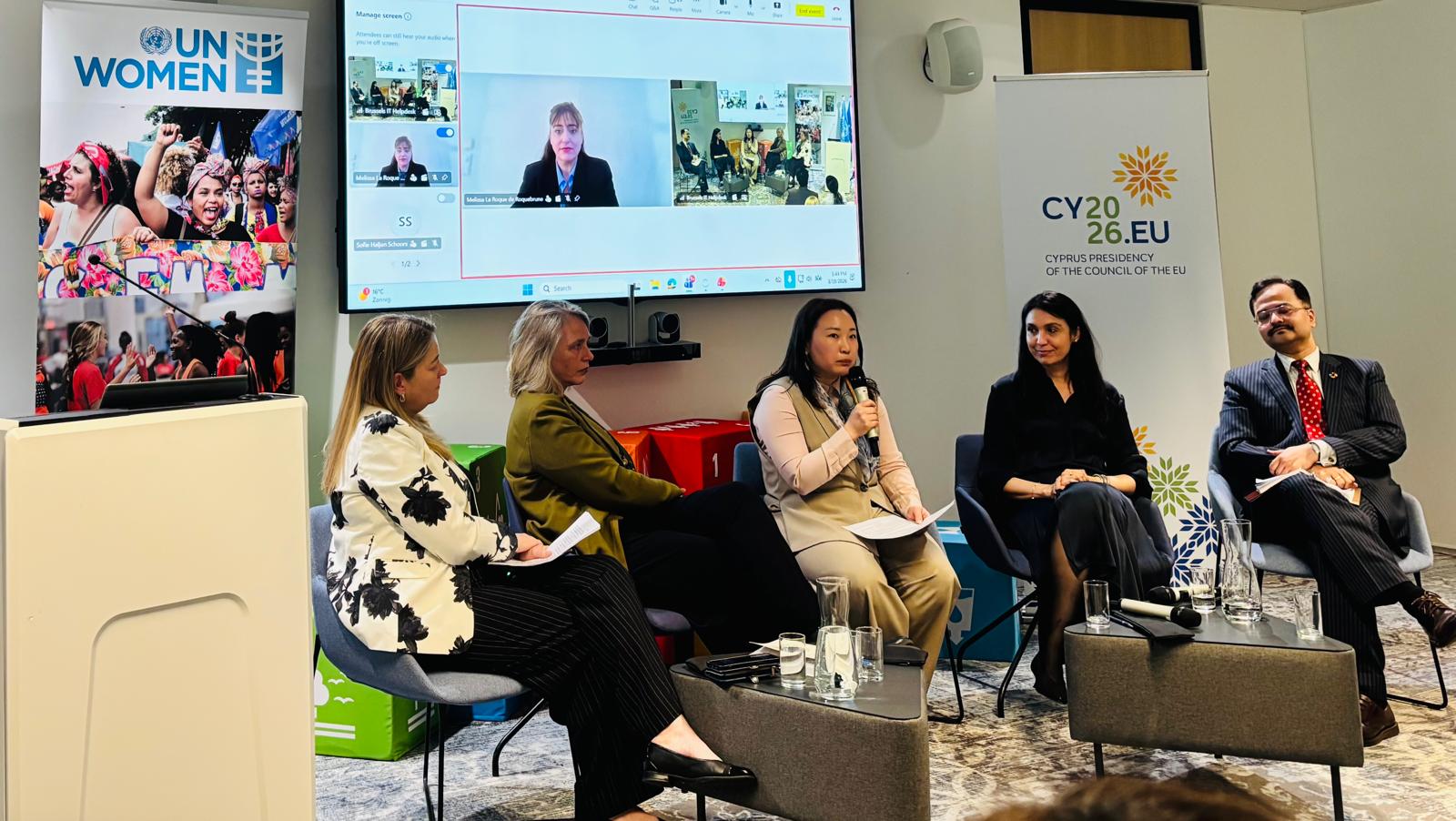
As the European Union launched consultations on its next Gender Action Plan for external action, GAP IV, UN Women brought together EU institutions, governments, development agencies, financial institutions, companies and civil society to consider how gender equality can be embedded across Global Gateway investments.
Held in Brussels on 19 March 2026, Team Europe for a Gender-Responsive Global Gateway: Advancing women’s economic empowerment through gender-lens investing and gender-responsive supply chains was organized by UN Women in partnership with the European Commission, the Cyprus Presidency of the Council of the European Union and Enabel (Belgian agency for international cooperation).
The event took place in the framework of the high-level event marking the launch of the GAP IV consultation. It provided a timely opportunity to bring practical experience and recommendations into the consultation and help ensure that gender equality is reflected not only in EU policy commitments, but also in investment decisions, project design, procurement and business operations.
Panelists represented the organizing partners, along with the Agence Française de Développement, BBVA Microfinance Foundation, European Investment Bank, German Agency for Business and Economic Development, Government of Thailand, Office of the United Nations High Commissioner for Human Rights, Schneider Electric, Sustainable Procurement Pledge and Symrise.
Embedding gender equality in Global Gateway investments
Global Gateway investments shape labour markets, supplier ecosystems and access to services and economic opportunities. Participants emphasized that these investments are not gender-neutral. Gender analysis and the meaningful participation of women workers, entrepreneurs, community leaders and women’s rights organizations must inform projects from the outset.
Applying a gender lens also requires financial institutions and development partners to address the criteria, procedures and structural barriers—including collateral requirements, digital exclusion, unpaid care and institutional bias—that restrict women’s opportunities. Stronger eligibility criteria, technical assistance and investment in care, safety and essential services can enable more women to benefit from infrastructure and economic development—and participate in the markets and supply chains these investments create.
GAP IV offers an opportunity to embed these expectations more systematically across Global Gateway investment decisions, implementation and accountability.
Extending impact through procurement and supply chains
Global Gateway projects are delivered through companies, contractors and extensive supplier networks. Their employment, sourcing and procurement practices determine how widely the economic benefits of investment are shared.
Procurement can therefore be a powerful lever for gender equality. Participants called for gender criteria to be integrated into purchasing decisions and for companies to conduct gender-responsive human rights due diligence throughout their supply chains, including among smaller businesses and lower-tier suppliers, where risks are often less visible.
The private-sector experiences shared during the event showed that progress requires sustained action: setting leadership and equal-pay targets, improving flexible work and family leave, assessing workplace conditions, strengthening women’s participation in supplier communities, and supporting suppliers to improve their own practices.
These efforts are most effective when companies are supported by practical tools, common approaches and opportunities to learn from one another. The Women’s Empowerment Principles provide a global framework for translating corporate commitment into action across leadership, workplaces, marketplaces and communities. The Global Supply Chain Coalition, co-led by UN Women and the German Agency for Business and Economic Development, complements this work by mobilizing companies and other partners around gender-responsive procurement, due diligence and supplier engagement, with particular attention to SMEs and lower-tier suppliers.
Ten recommendations for GAP IV and Global Gateway
The discussions resulted in ten recommendations for strengthening gender equality across Global Gateway investments:
- Make gender equality a core investment principle and performance requirement.
- Apply intersectional gender analysis from the outset.
- Ensure meaningful participation by women and local stakeholders.
- Invest in sectors that reduce structural gender inequalities.
- Strengthen gender-responsive procurement and due diligence.
- Increase financing for women’s economic empowerment.
- Expand gender-focused technical assistance.
- Promote coordinated action across Team Europe and its partners.
- Support long-term partnerships that transform gender norms and prevent gender-based violence.
- Establish transparent accountability and reporting mechanisms.
Together, these recommendations point to a central conclusion: gender equality must be built into the systems through which investments are selected, financed and delivered.
The GAP IV consultation provides an opportunity for the European Union to build on the achievements of GAP III while strengthening localization, private-sector engagement and accountability. UN Women stands ready to support this work through its gender equality expertise, its partnerships with women’s organizations, the Women’s Empowerment Principles and the Global Supply Chain Coalition.
By working together, the EU, its Member States, partner countries, financial institutions, companies and civil society can ensure that Global Gateway investments actively expand women’s rights, economic opportunities and leadership.