
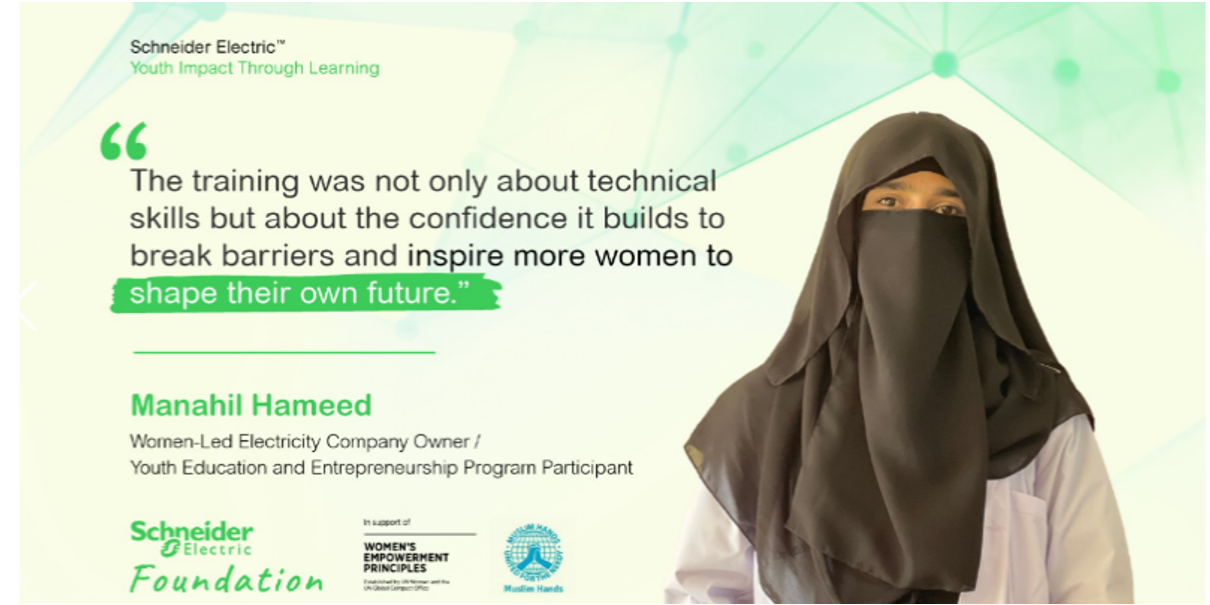
Manahil Hameed grew up in a small town – Balochistan, Pakistan – where women rarely enter technical fields: but she refused to let that define her future. Through Schneider Electric’s Youth Education & Entrepreneurship Program, supported by the Schneider Electric Foundation, she gained technical and business skills in energy management. She launched her own women-led electrical company, becoming Balochistan’s first female electrician.
Like many young women, she faced barriers to education, employment, and social expectations, but with the right support, she is now breaking stereotypes and creating opportunities not only for herself, but for others in her community.
Her journey reflects a broader challenge faced by many young women: access to education alone does not always translate into access to opportunity. Social expectations, limited professional networks and barriers to entering traditionally male-dominated sectors can continue long after training ends. With the right skills, confidence and support, young women can create opportunities for themselves and their communities.
Since 2009, Schneider Electric’s Youth Education & Entrepreneurship Program has worked to create those pathways. Operating in more than 60 countries and having trained over one million young people, the Program empowers youth to imagine their future with resilience and actively shape an inclusive energy transition through four complementary pathways: energy technical training; future skills and innovation; entrepreneurship & livelihoods development; and advocacy & social transformation.
For Manahil, this combination of technical knowledge and entrepreneurship translated into something tangible: the ability to build and lead her own business in a sector where women remain underrepresented.
Hear from Manahil, during a WEPs Deep Dive webinar last year >
The Program is rooted in strong local partnerships and equal opportunities for all, with particular attention to women and girls, marginalized groups and forcibly displaced communities affected by conflict or climate-related disasters. Through NGOs, educational institutions, public authorities and local partners, it connects technical learning with the confidence, networks and opportunities young people need to build sustainable livelihoods and contribute to an increasingly electrified future.
“We have seen our approach evolve alongside the needs and aspirations of young people. Technical skills remain essential, but lasting impact comes from combining education with resilience, entrepreneurship and strong local partnerships that enable young people to shape their own future. This is also where our engagement with the Women’s Empowerment Principles is particularly meaningful: helping us exchange good practices, strengthen gender-responsive approaches and create more opportunities for young women to participate, lead and thrive.” Diane LE GOFF, Global Leader Youth Education & Entrepreneurship CSR Program
This approach closely aligns with the Women’s Empowerment Principles, particularly Principle 6, which calls on companies to advance equality through community initiatives and advocacy. It demonstrates how private-sector expertise can extend beyond the workplace to help open pathways into skills, employment and entrepreneurship for women and girls.
Manahil’s story puts that ambition into human terms. When a young woman gains not only technical knowledge, but also the confidence and opportunity to apply it, the impact can extend far beyond one career. She can challenge expectations, create livelihoods, become a visible role model and help make the energy transition more inclusive for those who come after her.
Young women, particularly in rural and marginalized communities, face barriers to STEM education, entrepreneurship and decent work, reinforced by gender norms. Manah’s story shows how investing in young women’s skills can unlock entrepreneurship, challenge gender norms, and power more inclusive and sustainable economies.
International Youth Day 2026 recognizes that while young people’s lives are shaped by different national and local realities, their aspirations are remarkably similar. Across countries and communities, young people seek dignity, opportunity, meaningful participation, decent work, quality education, and a sustainable future.
This year’s theme places particular attention on young people living in Least Developed Countries (LDCs), Landlocked Developing Countries (LLDCs), and Small Island Developing States (SIDS), who often experience overlapping challenges linked to poverty, climate change, geographic isolation, limited economic opportunities, and unequal access to digital technologies. At the same time, these young people continue to demonstrate resilience, leadership, and innovation in advancing sustainable development within their communities and beyond.
Manahil Hameed didn't wait for the barriers around her to disappear. She built the skills to work past them, and now she's helping other young women do the same.
Companies wanting to advance gender equality can look at their own recruitment and workplace policies, engage with the communities around them and help women and girls.