
Can you believe that 1 in every 10 women is living in extreme poverty? By 2030, an estimated 8 per cent of the world’s female population will still be living on less than $2.15 a day, if this trend continues. That is approximately 342 million women and girls.
The private sector can play a crucial role in poverty reduction by creating employment opportunities for women living in poverty, enabling them to pave their ways out of poverty. Women are still more likely to be unemployed than men, and remains less likely to participate in the labour market than men due to various systemic issues.
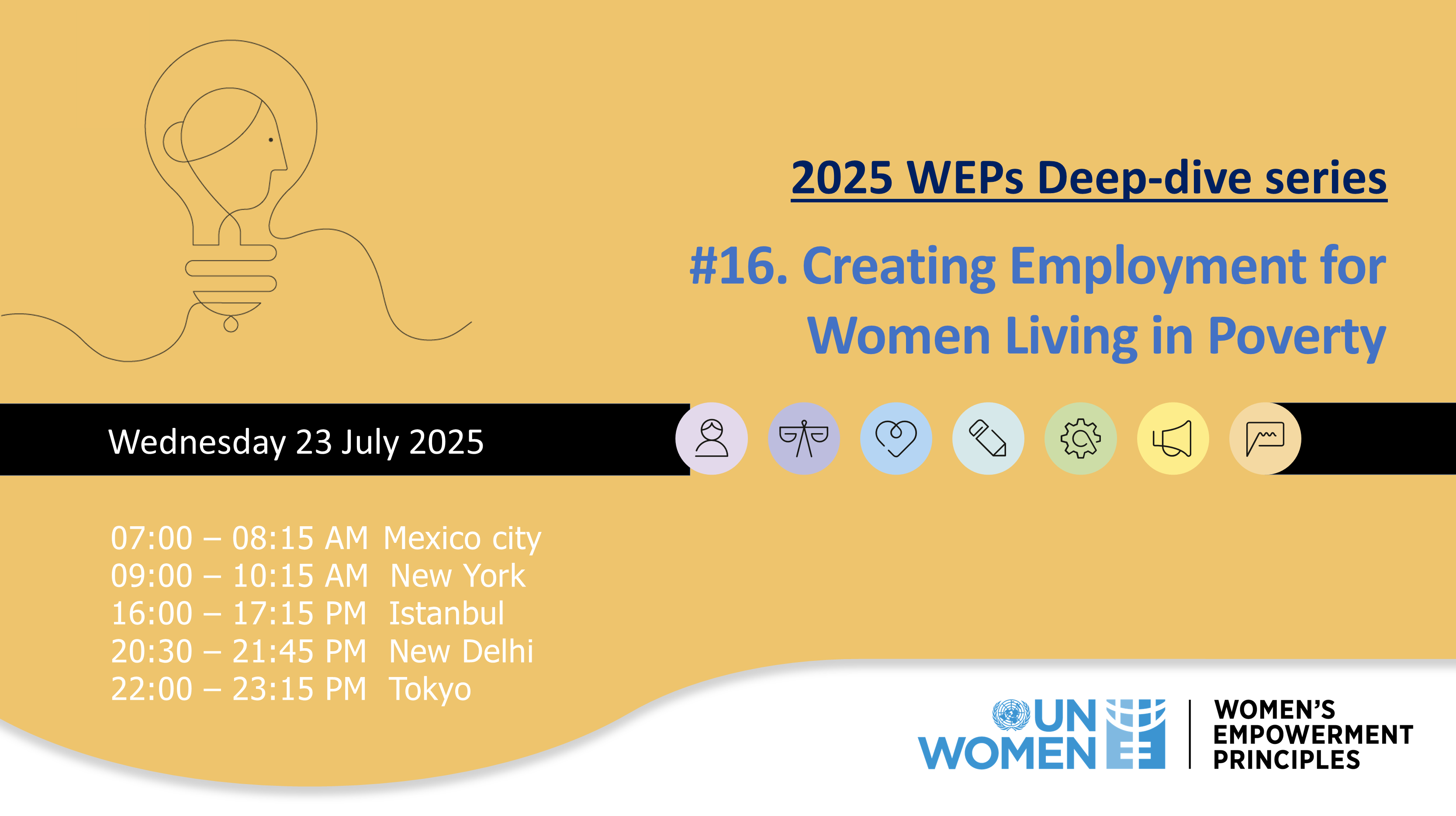
To learn how WEPs signatories are contributing to reduce poverty among women in their local community, UN Women invited three WEPs signatories and an NGO to join the 16th WEPs deep-dive webinar: Creating Employment for Women Living in Poverty. Part of the Beijing+30 webinar series, this session focused on how to expand employment opportunities for women living in poverty and address the economic barriers they face, including limited access to education, training and formal employment.
The webinar kicked off with opening remarks from Anna Falth, Global Head of the WEPs Secretariat at UN Women. Anna emphasized that businesses have a critical role to play by adopting inclusive hiring practices, gender-responsive procurement, and partnerships with grassroots organizations to unlock untapped talent. With gender equality recognized as the “unfinished business of our time,” Anna called on companies to embrace inclusive, sustainable business models that drive equality and dignity, particularly in a world facing intersecting global crises.
Business case for private sector investment in women’s economic empowerment
Nim Deshpande, Managing Director of Good Business Lab (GBL), emphasized that while there are ethical arguments towards investing in women’s economic empowerment, those arguments alone fail to convince the private sector to change the status quo, because business decisions are usually driven by profit considerations. For systemic change, companies must see tangible benefits to investing in women workers.
An NGO dedicated to improving workers’ lives, GBL’s research has proved that when firms invest in supporting their employees – from mental health support, skills training and more – the workers thrive and become more valuable to the company, thereby making it more profitable, innovative and resilient.
According to Nim, understanding both sides of the equation is crucial: what workers need to thrive; and what businesses prioritize. He emphasized that finding that overlap is the key, and that intersection is larger than many think. He shared evidence from two case studies that showed that gender-informed investments can reduce hiring costs, improve retention and boost productivity. He stated that companies can use operational data to show return on investment (ROI) and encouraged participants to start with pilot programmes.
Linking Livelihoods with Environmental Protection
Kim Heang Chhun, Head of Impact at IBIS Rice, a Cambodian WEPs signatory, presented their inclusive business model, which now sources from over 2,500 community farmers, 40 per cent of whom are women. IBIS Rice has integrated WEPs into its workplace, value chain and community engagement. Notably, the model connects organic rice production with wildlife and forest conservation, creating value for both people and the planet.
While IBIS Rice does not directly employ women within their company , it creates meaningful economic opportunities by working with women farmers in local communities. The company offers premium prices, up to 70 per cent above market rates, to farmers who meet organic standard and wildlife-friendly compliance (zero-deforestation and zero-poaching). Kim Heang emphasized that when women take on leadership roles in farmer groups, receive training in organic farming and financial literacy, and access pre-financing to stabilize their income, the impact is significant. As a buyer, IBIS Rice has invested $2.3 million in conservation premiums, leading to higher crop yields and greater financial independence for women.
Creating Circular Economies with Social Impact
Alp Aksoy, Vice President at Diversey, a Solenis company, and Izabela Ersahin, Executive Director of Sustainable Journey – the project’s implementing partner, showcased Linens 4 Life project. The initiative collects discarded hotel linens, upcycles them through women’s groups, and sells the finished products back to hotels. Alp and Izabela emphasized that this project is not a charity initiative but a procurement model: hotels are purchasing quality products created by the same women who upcycled them.
Linens for Life illustrates how gender equality and environmental sustainability can be integrated into corporate procurement systems, rather than treated as peripheral corporate social responsibility (CSR) activities. By creating a circular supply chain, the initiative reduces waste while generating income and skills for women. In one Turkish hotel alone, the pilot diverted 0.5 tons of linens from disposal, employed 35 women artisans, generated over 5,000 fair-wage work hours, produced 44,000 upcycled products and prevented 10 tons of CO₂ emissions.
To help women balance work and care responsibilities, the initiative offers flexible schedules and provides a safe environment where women can bring their children to work when needed. Izabela added “Linens for Life partners with small, locally rooted women producer groups, the work often allows for flexible schedules, and in many cases, these groups have spaces where children are welcome. While this may vary from place to place, it reflects a common approach to supporting women’s ability to balance work and care responsibilities.”
UN Women and Diversey are planning to launch an innovative partnership under the Surging Women's Employment Initiative (SWEI), that seeks to increase women's employment in the Arab States by 5 per cent by 2030. Under SWEI’s green pillar, this private sector partnership aims to employ 9,000 women across the 2,500 hotels in the Diversey hotel network, while reducing the hospitality industry’s global warming contribution by 60 per cent.
Inclusion for Refugee Women in Hospitality
Accor shared its programme supporting refugees in Brazil. Laís Fernanda Souza, Diversity, Equity and Inclusion Manager at Accor, explained how engaging refugee women aligns with Accor’s D&I commitment on gender equality, LGBTQ inclusion, people with disabilities and social, ethnic, racial and cultural diversity.
Refugee women often face intersecting barriers, including language challenges, lack of certification and gender discrimination, when rebuilding their lives. Accor addresses these challenges by providing hospitality industry training for refugee women in collaboration with UN Women and UNHCR. The impact so far has been significant: over 300 refugees were trained and hired, most of them women. Accor has committed to train 600 refugees and hire 208 by 2027, firmly embedding diversity and inclusion into its business strategy.
Empowering women means good business.
While many insightful questions were asked during the session, one key question focused on the sustainability of these projects. Isabel and Fernanda emphasized the importance of embedding these projects into the company’s core business strategy to ensure sustainable impact and genuine community contribution. Izabela added that true impact must be embedded within everyday operations, not treated as charity or CSR. Alp added that by aligning Linen4Life within their core values, Diversey is now scaling the project globally. He highlighted the circular economy approach, where waste is transformed into products that drive economic value and empower women.
Another key topic of discussion was return on investment. Since companies operate with clear financial motives, they are often cautious about investing in initiatives with uncertain outcomes. However, the participants clearly stated that supporting women in local communities has shown tangible economic benefits. For instance, while IBIS Rice pays a premium to source from women-owned farmers, they ensure a return on investment by shortening the value chain and reducing reliance on intermediaries. As Nick explained, the company manages recruitment, training, processing, packaging and marketing in-house, allowing profits to be reinvested directly into to farmers and producer groups. Nim added that having robust data and patience is essential, and concluded by affirming that, with the right incentives, the private sector can be a powerful drive of change.
Learn more about the event through watching the recording.