
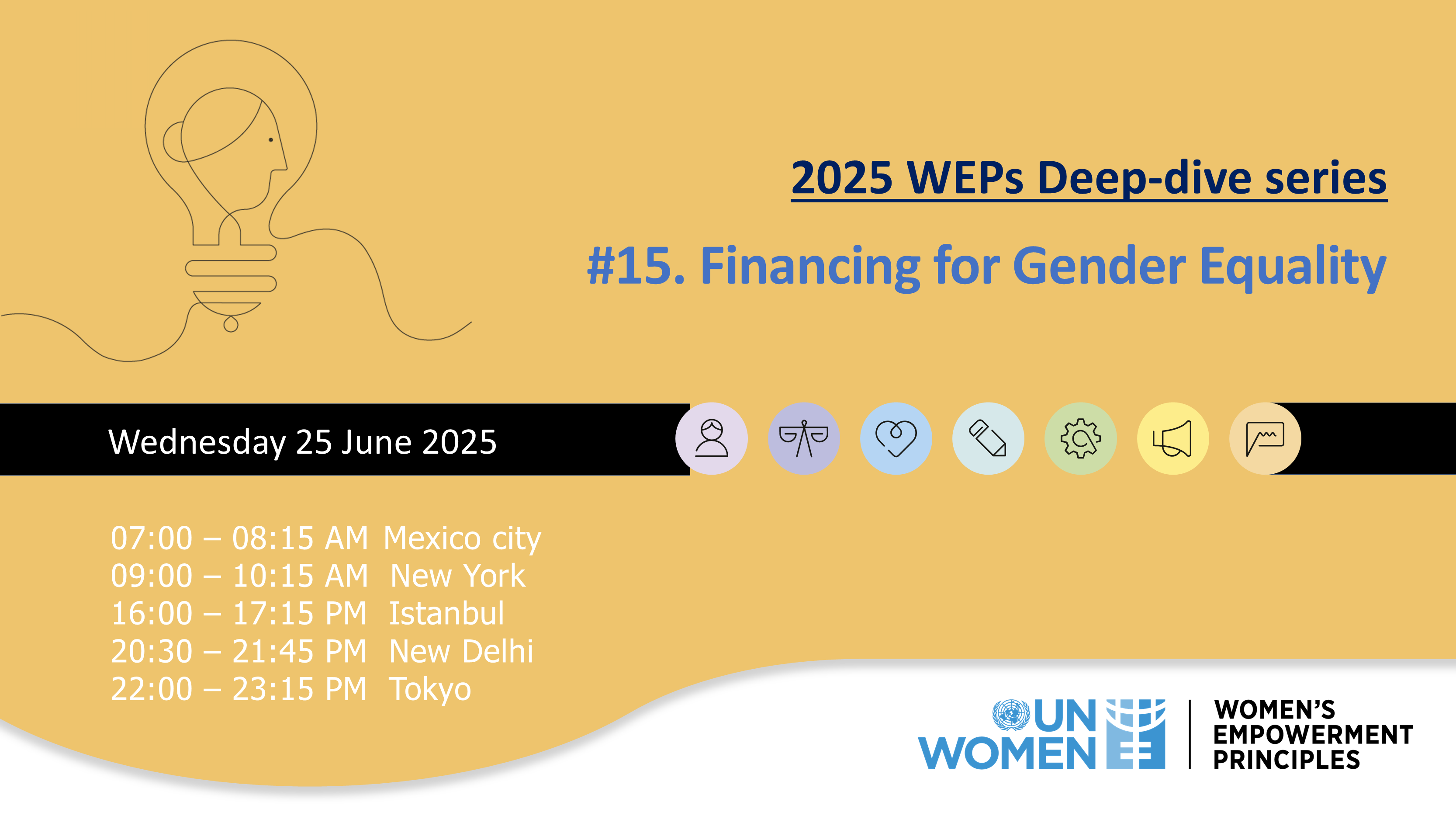
Gender equality is good for business. It boosts productivity, expands markets, and strengthens economies. Yet, it remains one of the most underfunded areas in global development. Only a small fraction of global aid, private finance, and philanthropic capital is explicitly directed toward advancing women’s rights, leadership, and inclusion.
The June 2025 session of the WEPs Deep Dive webinar series explored this persistent disconnect—what it will take to move from commitment to capital, and how companies, investors, and development actors can drive real impact through finance.
Hosted by the WEPs Secretariat at UN Women, the session brought together global experts from the Organisation for Economic Co-operation and Development (OECD), United Nations Sustainable Stock Exchanges Initiative (UNSSE), and UBS Global Wealth Management to explore the current global trends in gender lens investing. With development budgets under pressure and ESG frameworks facing scrutiny, the conversation made a strong case for treating gender equality as a central financing priority, not a fringe concern.
Why Financing for Gender Equality Can’t Wait
Anna Falth set the tone by urging a shift from commitment to action. “We have ample evidence that closing gender gaps can unlock trillions in global GDP,” she explained. “But right now, we’re still seeing a disconnect between intention and investment.”
She emphasized that the upcoming international conference on financing for development in Spain presents a pivotal opportunity to recalibrate financial systems and ensure gender equality is embedded into how capital is mobilized and allocated.
UN Women’s work through WEPs and other initiatives is focused on embedding gender into procurement practices, ESG standards, and financial decision-making. The aim is to make gender equality a strategic consideration across sectors, not just a philanthropic one.
Understanding the Landscape: Where the Money Is (and Isn’t)
Jenny Hedman, Policy Analyst on Gender Equality and Development at the OECD, shared sobering trends in development assistance. In 2023, 46% of bilateral Official Development Assistance (ODA) of members of the OECD Development Assistance Committee (DAC) included gender equality objectives—amounting to approximately USD $69 billion—while only 4-5% of that aid had gender equality as a primary goal. This figure has remained stubbornly low for years.
The data revealed stark disparities across sectors. Humanitarian assistance, governance, and energy remain major areas where gender equality objectives are often missing, while sectors like education and social protection fare better. Jenny pointed to this as a call for greater integration, particularly as ODA levels declined for the first time in six years and are projected to fall further by 2025.
She also highlighted that private finance mobilized by DAC members through public instruments reached USD $15 billion in 2023, yet only a third of this funding targeted gender outcomes. Philanthropic contributions told a similar story, with only about $4 billion going toward gender equality, much of it concentrated in health.
While tools like the DAC Gender Equality Policy Marker are helping track progress, Jenny called for deeper alignment between finance and impact. “We’re not seeing enough correlation between where gender inequality is greatest and where the funding is going,” she noted.
Unlocking the Power of Capital Markets
Landon Wilcock, Associate Economic Affairs Officer at UNSSE, turned the focus to private financial products. “We need capital markets to reward companies that advance gender equality,” he said.
Landon and his team had analyzed 11 types of gender-themed financial products—from ETFs and bonds to indexes and benchmarks. Encouragingly, many aligned with the WEPs, particularly around leadership and equal treatment. However, principles related to supply chains and community engagement were often overlooked.
The key challenge was data transparency. Many products made vague references to gender equality but lacked standardized KPIs or disclosures. “We’re seeing signs of ‘gender washing,’ where the language is there but the substance is weak,” Landon warned.
He called for the creation of globally accepted gender finance taxonomies—similar to those emerging for green finance—and stressed the need for more robust regulation and measurement frameworks. “Without consistent definitions, it’s hard for investors to know whether their money is truly driving impact.”
Gender Lens Investing in Practice
Antonia Sariyska, a Sustainable and Impact Investing Strategist, UBS Global Wealth Management, offered a practitioner’s view on what it means to apply a gender lens to investments. UBS manages nearly US$300 billion in sustainable and impact assets, and has developed a three-part framework: (1) investing for women (e.g., healthcare or financial inclusion), (2) investing in women (e.g., female entrepreneurs or leadership), and (3) investing by women (e.g., women’s role as investors).
Antonia emphasized that impact measurement needs to be investment-specific. “In financial inclusion, we can look at how many unbanked women gain access to credit. But in leadership-focused portfolios, we often have to rely on surface-level metrics like women on boards,” she explained. She acknowledged that the industry is still grappling with how to measure meaningful progress beyond representation.
While traditional views argue that gender lens investing yields less return on investment, return on investment in the long-term is not the issue, according to Antonia. In fact, gender lens portfolios at UBS have performed in line with traditional investments in the long-term, although they often concentrate in sectors like healthcare and finance where women’s representation is higher, creating unique performance risks and opportunities year-on-year.
Still, barriers persist—particularly in mobilizing capital for women-led initiatives in the Global South. Antonia highlighted the importance of blended finance models that combine philanthropic, public, and private capital to de-risk investment. She cited a successful outcomes-based finance model in India, where UBS partnered with the state government and NGOs to fund girls’ education.
Still, barriers persist—particularly in mobilizing capital for women-led initiatives in the Global South. Antonia highlighted the importance of blended finance models that combine philanthropic, public, and private capital to de-risk investment. She cited a successful outcomes-based finance model in India, where UBS partnered with the state government and NGOs to fund girls’ education.
Building a Financial System That Works for Women
The panelists closed the session by reflecting on what it would take to create financial systems that truly support women’s rights—not just in rhetoric, but in resourcing. There was broad agreement that both public and private capital have a role to play. Development finance remains essential for supporting grassroots feminist movements and civil society, while capital markets can provide scale, innovation, and accountability.
Frameworks like the WEPs offer a valuable roadmap for aligning business and investment strategies with gender equality. But as Antonia pointed out, “Every dollar of capital isn’t the same. We need different types of capital to meet different needs.”
The call to action was clear: embed gender into the core of financial systems, corporate decision-making, and policy frameworks. Whether through stronger reporting, more inclusive investment criteria, or partnerships that bridge global and local efforts, finance must be part of the solution.
As Anna reminded participants in her closing remarks, “When we shift capital to where it matters most, we create more equitable, resilient, and profitable outcomes—for everyone.”
You can watch the recording here.