
2025 marks the thirtieth anniversary of the Fourth World Conference on Women and the adoption of the Beijing Declaration and Platform for Action (1995). Beijing +30 calls on member states and other stakeholders, including the private sector, to act upon the unmet goals set thirty years ago.
To showcase good practices in the private sector, the WEPs Secretariat focused its 2025 WEPs Deep-Dive Series on the twelve priority areas, and provided a platform for WEPs signatories and their stakeholders to explore actionable approaches to advancing gender equality in the workplace, marketplace, and community.
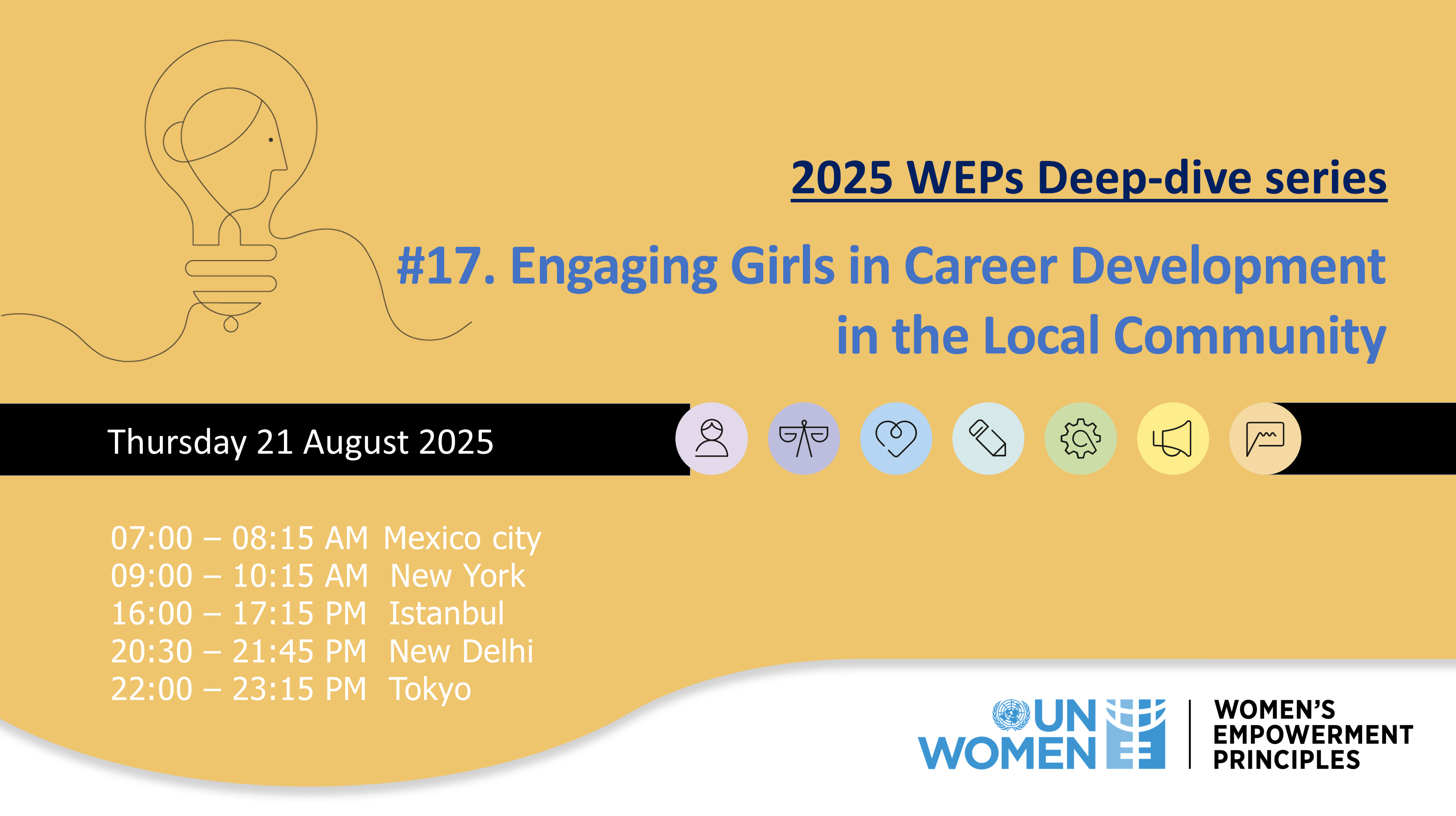
The last session of the Beijing+30 deep dive webinar series focused on “Engaging Girls in Career Development in the Local Community”. The Secretariat invited WEPs signatory companies to share their journeys on empowering girls in local community. Two girls, who have participated in WEPs signatories’ programmes, were also invited to share their experience.
In her opening remarks, Anna Falth, Global Head of the WEPs Secretariat at UN Women highlighted the critical importance of empowering girls. She emphasized that equipping girls with the right skills is essential for building inclusive, resilient societies and ensuring a strong talent pipeline. “Many girls still face systemic barriers, such as early marriage and household responsibilities.” Anna called on WEPs signatories to develop innovative partnerships that remove these barriers and provide real opportunities through education, mentorships, internships, and equitable workplace practices.
Mohammad Halim Kaminyar, CEO of Gloria Consulting, from Afghanistan shared the impactful work of his company to empower women and youth in Afghanistan through entrepreneurship and digital skills development. As an implementor of UNDP’s Afghanistan Hub for Entrepreneurship and Digitalization (AHEAD) Programme, Gloria Consulting provides business incubation, mentorship, training, and financial support to startups—many led by women. They have trained over 700 girls and launched a digital women’s network connecting 150+ women for collaboration and support. These programmes not only build capacity but foster a strong ecosystem for Afghan women to advance in education, business and leadership—paving the way for long-term social and economic empowerment.
A representative of UN Women in India, Bhumika Panwar, shared experiences from the Women Empower India (WE India) project. Bhumika explained how this EU-funded project is empowering young women and girls in India through partnerships with over 100 educational institutions focusing on STEM-related subjects along with tech companies. These partners have joined up to support young female STEM students in accessing employment and career opportunities. UN Women has facilitated the connection between girls and mentors in leading companies in India. Results from this project demonstrate that equipping girls with practical skills not only opens doors to employment but also empowers them to become entrepreneurs and leaders in their communities.
Representing one of the major corporate partners of WE India project, Susmita Malik, Vice President, Human Resources, at [24]7.ai, highlighted the company’s extensive efforts to empower women and girls in the community through education, investment and employment. As a WEPs signatory, the company has collaborated with UN Women on several impactful initiatives. One example is a job fair that created pathways to employment for girls and young women, including fresh graduates with no prior experience. To address deeper barriers to education for girls in India, the company invested in installing hygienic toilets in 130 government schools across five states, positively impacting more than 40,000 girls and helping to reduce school dropouts linked to poor sanitation. These initiatives reflect 24-7.ai’s strong commitment to inclusive growth and sustainable community impact.
To mark the special focus on girls, the WEPs Secretariat invited two girls who had participated in two different programmes of WEPs signatory companies.
- Manahil Hameed, a young woman from Pakistan, joined Schneider Electric’s youth entrepreneurship programme where she developed both technical and leadership skills. Equipped with this knowledge, she went on to found her own female-led electrical company. Driven to inspire others, she now encourages girls to start with whatever resource they have, proving that technical skills can empower not only individuals but also transform entire communities.
- Nabisawe Shaluwah, a teenage girl from Uganda, participated in Africa Girls Can Code Initiative (AGCCI), a UN Women project funded by Siemens AG. For her, AGCCI was not only about learning to code but also about building confidence, gaining digital skills and challenging stereotypes. Through the programme, she developed leadership and teamwork skills and was thrilled to contribute to a project where girls create solutions for Africa and the world. She shared her recommendations for companies interested in supporting similar programmes: “Skills empower girls to be future ready. Mentorship gives us role models to inspire and guide us. And sustainability ensures that the training continues beyond these projects”.
During the webinar, several key questions were raised.
- On inclusivity: Panelists encourage WEPs signatories to provide fair job opportunities by offering girls and young women internships and mentoring.
- On balancing education and skills development: Panelists explained that the skills training complements rather than replaces formal schooling, equipping girls with additional skills for future readiness.
- On participation: Panelists highlighted that girls come from diverse backgrounds, often rural or underserved areas, and received tailored support to overcome local challenges. The panel also clarified that all activities are age-appropriate, addressing concerns about child labour.
- On outreach: Panelists explained that girls typically learn about these programmes through community engagement, partnerships with schools and outreach events, which provided them with opportunities to express interest and enroll.
Throughout this inspiring session, participants were reminded that empowering girls is not only a goal in itself – it is a necessity for building a more inclusive and resilient future for all.
Together, we can build a world where every girl has the tools, confidence and opportunities to shape her own future and contribute to society. The time to empower girls is now.
Watch the recording here.