
When businesses understand the unpaid care responsibilities of their employees, they can develop workplace policies that respond to their needs and advance gender equality. Experiences from WEPs Signatories in Indonesia and Pakistan show how employee feedback and gender-disaggregated data can help companies turn commitments under the Women’s Empowerment Principles (WEPs) into practical action.
On 12 November 2026, UN Women’s WEPs Secretariat and the International Finance Corporation of the World Bank Group convened a global webinar to explore how private sector data can help businesses better understand and respond to employees’ childcare needs. The discussion highlighted how workforce data can inform family friendly policies, support employee well being and help businesses make better decisions about supporting and retaining their employees.
The scale of the global care gap remains significant. Nearly 350 million children below primary school entry age need childcare but lack access, while 708 million women are outside the labour force because of care responsibilities, compared with 40 million men.
These figures, shared by Anna Fälth, Head of the WEPs Secretariat at UN Women, highlight the connection between access to childcare and women’s economic opportunities. As she explained, “For parents, reliable, affordable, and quality childcare can determine whether they can take a job, remain in employment or pursue a promotion.”
The wider economic value of care responsive workplaces was another theme of the discussion. Amar Nijhawan of the International Development Research Centre described quality childcare as generating a “triple dividend”: expanding women’s economic opportunities, supporting children’s development and contributing to job creation, productivity and economic growth. He noted that stronger evidence can help investors identify opportunities in childcare enterprises and support investment in the wider care sector.
How companies are using data to understand what childcare delivers
For employers, this raises practical questions: Can employees afford the childcare available to them? Do existing services accommodate their needs? Are workplace policies reaching the people they are intended to support? Listening to employees and collecting reliable, gender disaggregated data can help companies answer these questions, identify gaps in existing support and determine where changes are needed.
From measuring employee feedback to business impact
For PT PLN (Persero), an Indonesian state owned electricity company and WEPs signatory, employee feedback provided a starting point for developing family friendly policies. Syahrial Amin, Senior Manager of Human Capital and Culture, explained that women make up around 20% of the company’s approximately 49,000 employees. Of these women, 78% of the women they employ are between 26 and 40 years old, a stage of life when many employees are balancing career development and family responsibilities.
Through annual employee experience surveys combining quantitative and qualitative feedback, PLN identified well-being as a priority to retain employees. Employees highlighted the need for longer parental leave and accessible daycare, particularly in major cities. The company used these findings to introduce various changes:
- inform policies aligned with WEPs Principle 2, which promotes fair treatment of women and men at work, and Principle 3, which focuses on employee health, safety and well-being.
- introduced a 10-module digital parental preparation programme in partnership with Mitra Keluarga Hospital.
- extended maternity leave from three to four months, with the possibility of extending it to six months, and
- increased paternity leave from three days to one month
- offer company-provided daycare support, includinges fully funded services at the head office, cost sharing arrangements and 57 facility only locations across Indonesia where employees can bring their children and babysitters.
The company also monitors how employees use these benefits - and how this impacts employee satisfaction and ultimately retention, productivity and costs. Its presentation reported maternity leave uptake of 97.73% and paternity leave uptake of 61.96%. Employee satisfaction with daycare services was rated 4.62 out of 5.
Ubuntu Care: Start with measuring the quality of services
Ubuntu Care, represents the perspective of a care enterprise: a Pakistan based early childhood development and education provider operating 10 corporate daycares across three cities. For providers, a key challenge lies in how employers understand and assess childcare support - and how to offer decent care services as well as working conditions for carers.
Its CEO and Co-Founder, Ahsan Jamil, observed that some companies still approach childcare as a compliance requirement:
“Employers frequently treat this as a tick-box exercise or see it as an employee perk rather than as an investment or as a strategic economic driver,” he said.
Ahsan also highlighted gaps in corporate data. Many companies focus on the cost and number of children served. However, whether the service is used depends on the quality and whether parents feel good about leaving their children in a care facility.
When information gathered or provided by companies is fragmented or anecdotal, it becomes difficult to assess how many employees use childcare, whether services meet their needs, what high-quality childcare provision costs and what outcomes it delivers.
At Ubuntu Care quality remains central: childcare should offer safe, nurturing and age appropriate developmental support through trained professionals, rather than simply providing a place for children to stay.
He also called for greater attention to the conditions of care workers, including fair compensation, manageable workloads, training and opportunities for career development.
Measuring progress and making the business case
The wider economic value of care responsive workplaces was another theme of the discussion. Amar Nijhawan of the International Development Research Centre described quality childcare as generating a “triple dividend”: expanding women’s economic opportunities, supporting children’s development and contributing to job creation, productivity and economic growth. He noted that stronger evidence can help investors identify opportunities in childcare enterprises and support investment in the wider care sector.
Alexandra Carter of the WEPs Secretariat encouraged companies to look beyond whether workplace policies exist and examine their effects on employees and the business. This includes monitoring who uses parental leave, identifying care-related barriers and examining how care responsibilities affect workforce retention.
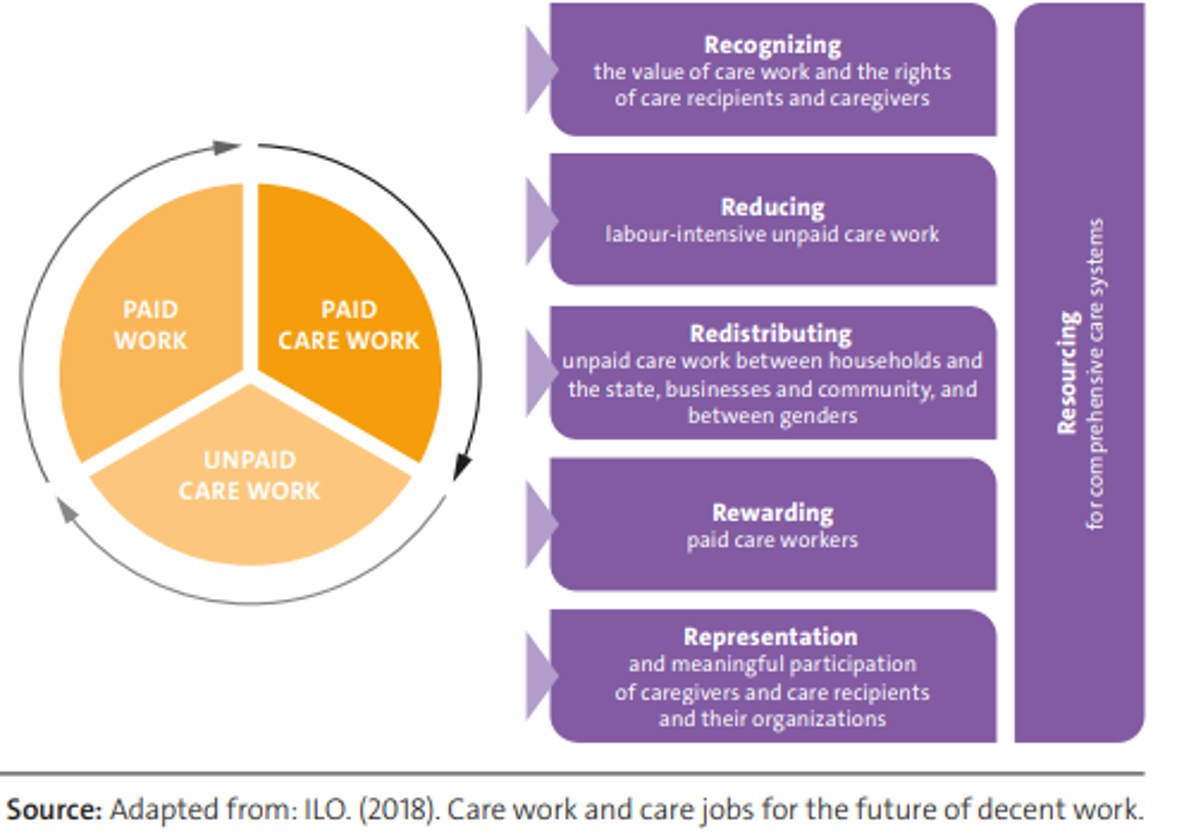
The WEPs 6R Framework for Care is often used for public stakeholders, but when adapted offers companies a structure that helps them measure their contribution to equal opportunities:
- Recognize care responsibilities and barriers. Use employee feedback and workforce data to understand needs and impacts on retention and progression.
- Redistribute who provides and pays for care through leave and childcare support. Measure uptake by gender, return-to-work and retention.
- Reduce unnecessary time and access burdens through flexible work and accessible care. Track use, access and time saved.
- Reward care work by ensuring company-supported care provides quality services and decent work. Assess service quality, wages and working conditions.
- Represent caregivers, care workers and users in decisions. Track who participates and whether their input changes policies or services.
- Resource commitments with adequate money, people and systems. Monitor budgets, coverage, uptake and outcomes.
Together, these measures help companies see not simply what they provide, but who benefits, whether it works and what changes as a result.
When businesses listen to their employees, invest in care-responsive policies and track their outcomes, they can take practical steps towards more inclusive workplaces and greater gender equality.
Written by Nina Cynthia
Image Credit: UN Women/MR Hasan