
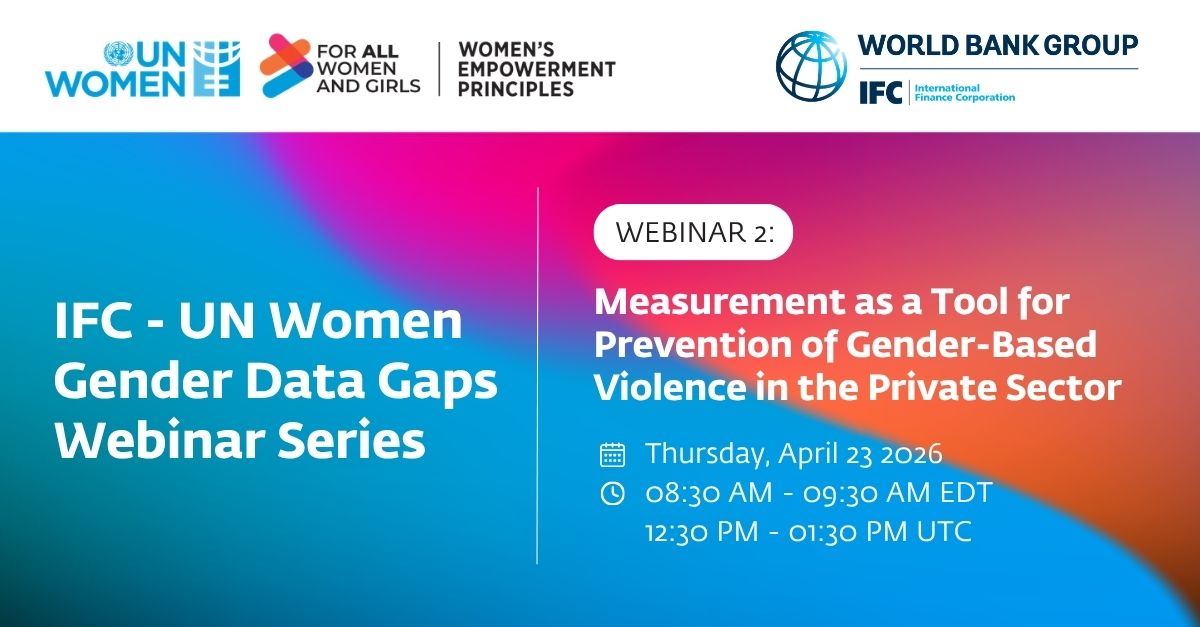
On 23 April 2026, IFC and UN Women convened private sector leaders, practitioners, and researchers for the second session in their joint data series on gender data gaps. The focus was clear and urgent: how can companies move from policies and commitments to effective prevention of gender-based violence and harassment (GBVH)—using data as a foundation for action?
What emerged from the discussion is both practical and instructive. Companies are not starting from zero. Many have policies, training, and commitments in place. But what distinguishes those making real progress is their ability to measure, understand, and act on GBVH as a business issue.
Making the invisible visible
A central challenge remains that GBVH is often underreported. Fear of retaliation, stigma, and lack of trust in reporting systems mean that incidents frequently remain hidden. For companies, this creates a critical blind spot: without data, risks cannot be identified and interventions cannot be targeted.
As emphasized throughout the session, measurement is not about reporting for its own sake—it is about visibility. It helps companies understand where risks occur, how they manifest, and which groups are most affected.
UN Women’s latest guidance Normalized no more: An evidence-based guide to measuring sexual harassment highlights a shift that companies need to make to ensure they are collecting the right data, in a responsible and safe manner. Instead of relying on high-level or binary questions, effective measurement requires capturing:
- different forms of harassment, including online and technology-facilitated abuse
- the contexts and power dynamics in which it occurs, including on the way to work or in business travel
- frequency and repetition
- impacts on employees and operations
- and workplace norms that shape behavior
This approach allows companies to move from anecdotal understanding to evidence-based decision-making.
What works in practice: lessons from companies
The discussion brought these principles to life through concrete company experiences—demonstrating how data can drive both policy and culture change.
At Vodafone, data was the starting point for recognizing gender-based violence—particularly domestic violence—as a workplace issue. Research commissioned by UN Women with the support of Vodafone Foundation showed not only the scale of the issue, but also its business impact: employees affected by violence were more likely to miss work, lose productivity, and face barriers to career progression.
This evidence led Vodafone to implement a global policy on domestic violence, including 10 days of paid safe leave for survivors, workplace adjustments to ensure safety, and a trained internal network of “allies” to support employees confidentially.
Crucially, the company chose not to formally track the use of safe leave in HR systems—prioritizing confidentiality and trust over data completeness. This reflects an important lesson: not all data needs to be collected if it risks undermining employee safety.
Complementing this, the Vodafone Foundation’s Bright Sky app demonstrates how anonymized data can inform action at scale. With over 1.6 million downloads across 13 countries, the tool shows that many users first seek to understand what constitutes abuse—highlighting the importance of awareness as a first step. Increasing use of online safety features also signals the growing relevance of technology-facilitated violence.
For Adjara Group in Georgia, the journey began with implementing a sexual harassment prevention mechanism in partnership with UN Women. What made the difference was leadership commitment—including strong engagement from senior management—which enabled the company to tackle what was initially a sensitive and often taboo topic.
Adjara Group combined incident tracking with regular employee surveys and conversations, allowing them to monitor not only reported cases, but also awareness, perceptions, and trust in reporting systems. They also partnered with experts and developed and delivered in-house training and awareness-raising, which was especially important to create a common language and understanding amongst their young workforce - many of whom are entering the world of work for the first time with Adjara Group.
One of their most important insights challenges a common assumption: an increase in reported cases is not necessarily a negative outcome. Instead, it can signal that employees feel safer to speak up and trust that the company will respond. For Adjara Group, rising reporting rates reflected growing transparency and accountability, rather than increased incidence.
At the same time, their experience highlights practical challenges—particularly in sectors like hospitality, where employees interact with clients and operate across diverse regional contexts. Building trust and addressing cultural barriers required sustained communication, training, and localized approaches.
The business case: why data matters
Beyond individual company experiences, IFC’s research reinforces why measurement is essential. Studies show that GBVH has tangible economic costs, including absenteeism, reduced productivity, and staff turnover. In some contexts, this can amount to significant losses at company and national level, underscoring that GBVH is not only a human rights issue, but a material business risk.
Importantly, the discussion emphasized that violence is not confined to the workplace. Experiences of domestic violence often carry over into work, affecting performance and well-being. Companies that recognize this continuum of violence are better positioned to design effective responses.
From measurement to action: what companies can do
Across the session, a clear set of lessons emerged for companies and WEPs Signatories:
- Start with the right data. Move beyond tracking complaints to understanding behaviors, contexts, and impacts.
- Build trust before measuring. Without confidentiality and credible response mechanisms, employees will not disclose experiences.
- Interpret data carefully. Increased reporting can indicate progress in awareness and trust—not failure.
- Link data to decisions. Measurement should inform policies, training, and operational changes—not remain a standalone exercise.
- Recognize GBVH as a business issue. Addressing it strengthens productivity, retention, and risk management.
- Take a holistic approach. Workplace harassment, domestic violence, and online abuse are interconnected and require integrated responses.
The companies featured in this discussion demonstrate that progress is possible—and that it begins with a shift in mindset. From viewing GBVH as a sensitive or external issue, to recognizing it as a core part of workplace governance and performance.
Safer, more inclusive workplaces are built through intentional action, informed by evidence, and sustained by leadership.
Watch the full session here
This blog summarizes the conversation between the following speakers:
- Namita Datta, Principal Economist, Gender Department, World Bank Group
- Anna Fälth, Global Head WEPs Secretariat, UN Women
- Raphaelle Rafin, Policy Specialist EVAW, UN Women
- Dan Neilson, Senior Global Diversity and Inclusion Manager, Vodafone
- Jemima Gawn, Global Diversity and Inclusion Manager, Vodafone
- Anastasia Zurabishvili, Corporate Communications Lead, Adjara Group
- Lilian Onsongo, Global GBV Operations Officer, IFC Respectful Workplaces Program