
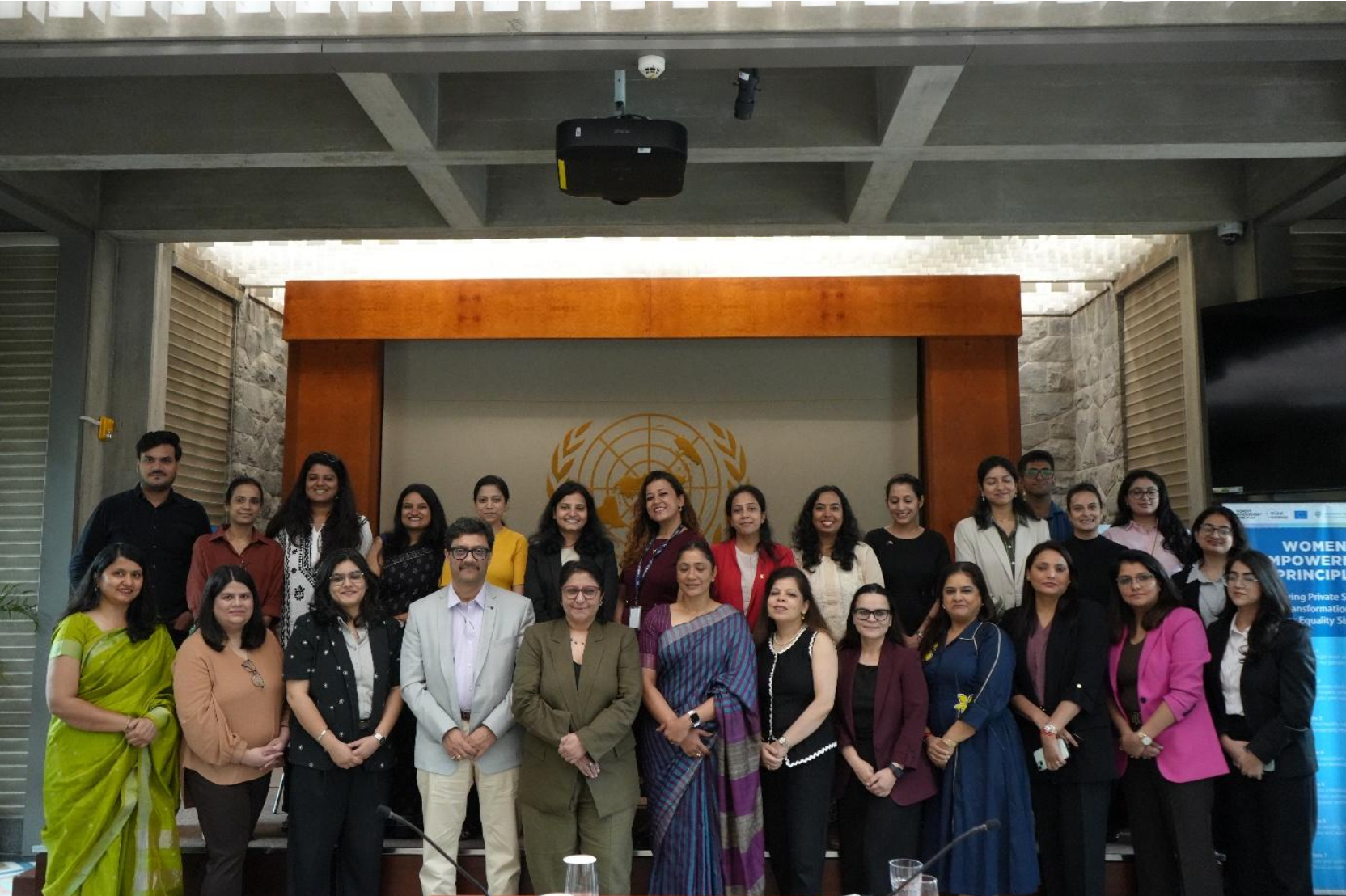
UN Women India, in partnership with the Federation of European Businesses in India (FEBI) and with support from the European Union under the Women Empower India (WE India) Programme, organized a half-day session on "Equality Means Business: Advancing Gender Equality through the Women's Empowerment Principles (WEPs)" on 2 July 2026 at UN House, New Delhi.
The session brought together 32 representatives from FEBI member companies headquartered in Germany, France, Denmark, Switzerland, Belgium, and other European countries operating in India, alongside representatives from the Embassy of Germany, the Indo-German Chamber of Commerce (IGCC), WEPs Signatories, and industry associations. The discussion focused on how businesses can strengthen gender equality within their organizations while contributing to women's economic empowerment. Participants represented a wide range of sectors, including manufacturing, renewable energy, healthcare, technology, logistics, consumer goods, consulting, and professional services.
The programme commenced with welcome remarks by Suhela Khan, Country Programme Manager, UN Women India, who highlighted that gender equality is not only a social responsibility but also makes strong business sense. She encouraged companies to view the Women's Empowerment Principles as a practical framework for embedding gender equality across leadership, workplaces, marketplaces and communities. Participants also viewed a special video message from Shoko Ishikawa, Country Representative, UN Women India. Sonia Prashar, Secretary General of FEBI, welcomed participants and reiterated FEBI's commitment to promoting responsible and inclusive business practices among its member companies.
The session included an introduction to the Women's Empowerment Principles (WEPs) and the Women Empower India (WE India) Programme. Participants were introduced to the global WEPs framework, its seven principles and the business case for gender equality. The discussion highlighted how companies can strengthen leadership commitment, create inclusive workplaces, improve women's participation across the workforce and contribute to gender equality through their value chains and community engagement.
A key highlight of the event was hearing directly from three WEPs Signatories that shared their experiences of implementing gender-responsive policies and practices.
Suzlon Energy shared how gender equality has been integrated into its business through leadership commitment, governance mechanisms and measurable diversity goals. The presentation highlighted initiatives to increase women's participation in renewable energy through inclusive recruitment, women technician programmes, mentorship, STEM outreach and supplier diversity. The company also discussed how employee resource groups and gender-responsive workplace policies are contributing to a more inclusive organizational culture.
Wipro presented its long-standing approach to diversity, equity and inclusion, demonstrating how inclusion has been embedded across recruitment, leadership development, employee well-being, supplier diversity and community programmes. The company also shared examples of initiatives supporting women returning to work, leadership development and digital skilling.
[24]7.ai showcased its journey towards creating a more inclusive workplace through diversity hiring, women leadership programmes, mentoring, flexible work arrangements and returnship initiatives. The company also shared how its community programmes are supporting girls' education, employability and digital learning.
The presentations were followed by an interactive discussion where participants exchanged experiences and reflected on practical approaches to advancing gender equality within their organizations.
Several participants noted the value of learning directly from peer companies that are implementing theWEPs. The discussion reinforced that while organizations are at different stages of their gender equality journey, many share similar challenges and can benefit from exchanging practical experiences and solutions.
The event also provided an opportunity for companies to learn more about UN Women's ongoing engagement with the private sector through the WEPs, the Women Empower India (WE India) Programme and other initiatives that support businesses in strengthening gender-responsive policies and practices.
The session concluded with a shared commitment to continue building partnerships that advance women's economic empowerment. UN Women and FEBI encouraged participating companies to deepen their engagement with the WEPs, strengthen implementation within their organizations and continue sharing good practices that can inspire broader action across the private sector.
Key Takeaways
- Participants gained a stronger understanding of the Women's Empowerment Principles as a practical framework for advancing gender equality in the private sector.
- The exchange of experiences from representatives of Suzlon Energy, Wipro and [24]7.ai enabled participants to identify practical approaches and good practices for advancing gender equality within their organizations.
- The session reinforced collaboration between UN Women, FEBI and participating companies, laying the groundwork for continued engagement to advance women's economic empowerment.